archaeology
Showing posts with label archaeology. Show all posts
Pearl Blay
archaeology
cultural
feature designer
historical

Antique, Recycled and Handmade Beads from Africa Supplied by itaitoimports

Nata Kristin of New York based itaitoimports specializes in "artisan-made and rare vintage beads. Our focus is hand-made, sustainability, and authenticity when sourcing beads from Africa, Afghanistan and Tibet."
It's a wonderful fair trade service as it allows jewelry designers to purchase beautiful and unique handmade beads from artisans in far off places. This in turn provides artisans with a means of support. Itaito sources their handmade beads directly from the makers.
Pearl Blay
archaeology
historical
metal work
royalty

The Discovery of the Sutton Hoo Treasures as Told in the Movie The Dig

Sutton Hoo, located in Suffolk (north-east of London), is the site of richest archaeological find in British history. The extraordinary discovery of a ship burial site has been retold Netflix's new offering, The Dig, starring Carey Mulligan and Ralph Fiennes. The movie is based on the historical novel of the same name, by John Preston.
While the movie displayed creative license with historical fact, the central plot is true. A wealthy widow, Edith Pretty, who had an interest in archaeology, hired a local self-taught archaeologist (and astronomer), Basil Brown to dig the 18 burial earth mounds or "barrows" on her property.
Pearl Blay
archaeology
feature designer
historical
necklace
 Inspiration can also come from the past. In the case of Vault of Valhalla, one of my Twitter followers, the really distant past!
Vince Zahle, the artisan behind the designs thoroughly researches archaeological finds to come up with the lost wax cast jewelry created from his hand sculptured molds.
Vault of Valhalla - Viking, Celtic and Anglo-Saxon Inspired Jewelry

Vince Zahle, the artisan behind the designs thoroughly researches archaeological finds to come up with the lost wax cast jewelry created from his hand sculptured molds.
Pearl Blay
archaeology
auction
biography
famous gemstone
historical
royalty
science
 This spectacular historic jewel was recently auctioned. It once belonged to Catherine the Great (1729-1796) one of Russia's most colorful rulers. (You can read the bejeweled mini-biography I wrote about her for more juicy details.) Her emerald and diamond brooch sold for $1.65 million, well above the pre-auction estimate of $1- 1.5 million. A worthy price for one of the most outstanding gemstones in the world.
Catherine the Great's Colombian Emerald and Diamond Brooch

Pearl Blay
archaeology
bracelet
earrings
historical
museum
tiara
Afghanistan : Hidden Treasures Exhibition
A remarkable exhibition of Afghanistan's Hidden Treasures from the National Museum in Kabul has been touring for the past few years. The exhibition is now at the Canadian Museum of Civilisation in Ottawa until March 28, 2010. The introductory National Geographic trailer here is well worth the view as it puts into context the significance of these archaeological finds. The cultural history of a people is indeed the very soul of a nation.

Pearl Blay
archaeology
historical
museum

The Incredible Gold Ornaments of the Staffordshire Hoard

The story of the incredible Anglo-Saxon archaeological find in England called the Staffordshire Hoard ( (Above Image Source) is remarkable not only because it is a significant discovery but because it vindicated big time, the efforts of a metal detector enthusiast - 55 year old unemployed Terry Herbert who lives alone in assisted housing and on disability benefit. He said it was" more fun than winning the lottery."
Pearl Blay
archaeology
brooch
historical
museum
necklace
rings
Treasures of the Black Death Exhibition
Dark Side of Black
Part 2 of 2
London’s Wallace Collection is currently displaying until mid-May one of the most moving and touching exhibitions of 14th century jewelry and other treasures. If you are lucky enough to live near London or are planning to visit soon, this exhibition is worth a visit to see what medieval fashion jewelry was like and the skill of the craftsmen of the time. But much more than that, to also appreciate a different perspective of the medieval period.
These artifacts were from the time of the Black Death, when mankind's deadliest pandemic killed an estimated 75 million people worldwide. About 50% of Europe`s population, some 25-50 million people, perished.
Bubonic plague terrified medieval populations. The bacterium Yersinia pestis was transmitted via flea bites. The fleas were in turn spread by rats. Populations who lived closer together were naturally at greater risk. The disease is an infection of the lymphatic system resulting in gland swellings called buboes which could lead to septicemia (blood poisoning) if the buboes hemorrhaged and pneumonic plague if it spread to the lungs. Half the victims were dead in 4-7 days. It was an agonising way to die.
With no knowledge of what actually caused the disease nor access to modern antibiotics, people desperately sought scapegoats and solutions. Minorities such as Jews, foreigners and the unfortunate dregs of society like lepers and beggars were all targeted. Some solutions were bizarre. For example, a recent archaelogical dig in Italy (a fascinating read if you're not squeamish) revealed the remains of a 16th century female plague victim buried with a brick stuck in her mouth to prevent her from becoming a vampire or "shroud-eater".
The treasures from the Wallace collection were found in two separate hoards, one in Colmar, France and the other in Erfurt, Germany, near the 11th century synagogue, the oldest in Europe (below).

Some of the highlights of the exhibition are the most personal of items like the exquisitely crafted gold Jewish wedding ring (below) engraved with the words mazel tov or good fortune. The house design symbolised both the marital home and the Temple of Jerusalem. It is one of the earliest Jewish wedding rings ever found.
Some time in early 1349, the unknown owner of this ring buried her precious jewelry and valuables. The Black Death had became a doubly perilous time for Jews because they were collectively accused of poisoning wells. On March 2 that same year, this woman and her family were amongst the 1000 innocent Jews killed in Erfurt by ignorant mobs. Such hoards were thus never recovered by their owners.

This beautiful Colmar brooch was adorned with sapphires, rubies, garnets and pearls :

This is a toilet set complete with bottle and cosmetic accessories:

Images By Kind permission of the Trustees of the Wallace Collection.
______________________________
Original Post by THE BEADING GEM
Jewelry Making Tips - Jewelry Business Tips


Part 2 of 2
London’s Wallace Collection is currently displaying until mid-May one of the most moving and touching exhibitions of 14th century jewelry and other treasures. If you are lucky enough to live near London or are planning to visit soon, this exhibition is worth a visit to see what medieval fashion jewelry was like and the skill of the craftsmen of the time. But much more than that, to also appreciate a different perspective of the medieval period.
These artifacts were from the time of the Black Death, when mankind's deadliest pandemic killed an estimated 75 million people worldwide. About 50% of Europe`s population, some 25-50 million people, perished.
Bubonic plague terrified medieval populations. The bacterium Yersinia pestis was transmitted via flea bites. The fleas were in turn spread by rats. Populations who lived closer together were naturally at greater risk. The disease is an infection of the lymphatic system resulting in gland swellings called buboes which could lead to septicemia (blood poisoning) if the buboes hemorrhaged and pneumonic plague if it spread to the lungs. Half the victims were dead in 4-7 days. It was an agonising way to die.
With no knowledge of what actually caused the disease nor access to modern antibiotics, people desperately sought scapegoats and solutions. Minorities such as Jews, foreigners and the unfortunate dregs of society like lepers and beggars were all targeted. Some solutions were bizarre. For example, a recent archaelogical dig in Italy (a fascinating read if you're not squeamish) revealed the remains of a 16th century female plague victim buried with a brick stuck in her mouth to prevent her from becoming a vampire or "shroud-eater".
The treasures from the Wallace collection were found in two separate hoards, one in Colmar, France and the other in Erfurt, Germany, near the 11th century synagogue, the oldest in Europe (below).
Some of the highlights of the exhibition are the most personal of items like the exquisitely crafted gold Jewish wedding ring (below) engraved with the words mazel tov or good fortune. The house design symbolised both the marital home and the Temple of Jerusalem. It is one of the earliest Jewish wedding rings ever found.
Some time in early 1349, the unknown owner of this ring buried her precious jewelry and valuables. The Black Death had became a doubly perilous time for Jews because they were collectively accused of poisoning wells. On March 2 that same year, this woman and her family were amongst the 1000 innocent Jews killed in Erfurt by ignorant mobs. Such hoards were thus never recovered by their owners.
This beautiful Colmar brooch was adorned with sapphires, rubies, garnets and pearls :
This is a toilet set complete with bottle and cosmetic accessories:
Images By Kind permission of the Trustees of the Wallace Collection.
______________________________
Original Post by THE BEADING GEM
Jewelry Making Tips - Jewelry Business Tips
Pearl Blay
archaeology
beader design
earrings
historical
vintage
Sunburst Vintage Brass Earrings, Sun Symbols and Newgrange
Paula really liked the vintage sunburst earrings I had on my rack so she had a go at creating her own version. I had used an orangish red glass pearl in mine. Paula decided on orange crackle beads which really does suggest an inferno if you look into the beads! The vivid color proved a good contrast and brightened up what is a subdued metal.

 There are many forms of solar symbols of which rayed versions like the one above are still popular today. Rayed depictions of the sun appear on several national flags. One of the earliest symbols is a simple dot within a circle which in Egyptian hieroglyphics meant "Ra" or sun.
The triskelion or triskele is another symbol which may be a sun symbol - the design may interest and challenge wire artisans! It is depicted as three interlocked spirals as shown or as a spiral of three bent human legs.
 A related symbol is the ancient Celtic triple spiral which was found in a Neolithic tomb at Newgrange in Ireland. This symbol symbolised the sun, the afterlife and reincarnation.
Newgrange is an amazing site for it is more than just a tomb. The passage and chamber is illuminated by the winter solstice sun. At sunrise on December 21, the shortest day of the year, a thin ray of sunlight starts to penetrate the tomb from the roofbox which was designed to catch the beam (see video). For about 14-17 minutes, around 9 am, the entire chamber is lit. This site was built more than 5,000 years ago - 500 years before the Great Pyramids. Newgrange also predates Stonehenge by 1,ooo years!!
Some believe the triple spiral is a symbol of pregnancy, each spiral representing a trimester as the sun describes a spiral in its movements every three months. The three spirals were also drawn in one continuous line which suggest rebirth and reincarnation.
The spirals can be seen on the stone in front of the entrance in the photo by Maxrush (below left). The roof box is the rectangular hole at the top of the entrance. The photo on the right by Jimmyharris shows the entire tomb.


Beader Design #: 470 ______________________________ Original Post by THE BEADING GEM Jewelry Making Tips - Jewelry Business Tips

 There are many forms of solar symbols of which rayed versions like the one above are still popular today. Rayed depictions of the sun appear on several national flags. One of the earliest symbols is a simple dot within a circle which in Egyptian hieroglyphics meant "Ra" or sun.
 The triskelion or triskele is another symbol which may be a sun symbol - the design may interest and challenge wire artisans! It is depicted as three interlocked spirals as shown or as a spiral of three bent human legs.

 A related symbol is the ancient Celtic triple spiral which was found in a Neolithic tomb at Newgrange in Ireland. This symbol symbolised the sun, the afterlife and reincarnation.
 Newgrange is an amazing site for it is more than just a tomb. The passage and chamber is illuminated by the winter solstice sun. At sunrise on December 21, the shortest day of the year, a thin ray of sunlight starts to penetrate the tomb from the roofbox which was designed to catch the beam (see video). For about 14-17 minutes, around 9 am, the entire chamber is lit. This site was built more than 5,000 years ago - 500 years before the Great Pyramids. Newgrange also predates Stonehenge by 1,ooo years!!
Some believe the triple spiral is a symbol of pregnancy, each spiral representing a trimester as the sun describes a spiral in its movements every three months. The three spirals were also drawn in one continuous line which suggest rebirth and reincarnation.
The spirals can be seen on the stone in front of the entrance in the photo by Maxrush (below left). The roof box is the rectangular hole at the top of the entrance. The photo on the right by Jimmyharris shows the entire tomb.


Beader Design #: 470 ______________________________ Original Post by THE BEADING GEM Jewelry Making Tips - Jewelry Business Tips
Pearl Blay
archaeology
biography
historical
museum
royalty
 One day back in September of 1985, a metal detectorist, Ted Seaton, walked near the ruins of Middleham Castle in Yorkshire, northern England and discovered one of the most famous archaeological finds ever - the Middleham Jewel. The solid gold pendant weighing 68 grams is beautifully engraved with the Trinity and nativity and set with a large sapphire. It is highly likely it was a reliquary containing a holy relic - an amulet meant to protect the wearer. There is a charm against "falling sickness" (epilepsy) written in Latin on the border. It was eventually bought by Yorkshire Museum for a staggering £2.5 million or $3.6 million in order to keep this fine piece of English Gothic jewelry in the country.
No one knows who the jewel belonged to. But it has been dated back to the 15th century to around the lifetime of Middleham Castle's most famous occupant - the controversial King Richard III (1452-1485). This castle was once known as the Windsor of the North and was home to many powerful lords. The picture below shows the remains of the kitchen area - the round circles on the ground were the locations of the ovens.


Middleham Castle was Richard III's favourite residence. The castle was where he spent his happiest years of his life and where his son and heir was born. He lived there in his formative years when he was being trained in the knightly skills under the tutelage of Richard Neville, the Earl of Warwick. It was there he met the two boys who were to be his life long friends and where he first met his future wife, Anne Neville, the younger daughter of the Earl.
His portrait shows a good looking man but his unsmiling face and the deep furrows in his forehead gives him a serious and careworn expression. It aptly reflects his personality and the short, tragic and eventful life he led. He was born just at the start of England's series of civil wars known as the Wars of the Roses. He spent his entire life embroiled in the messy conflicts where the Houses of Lancaster and York battled for the English throne. It was a terrible time because the nobles were constantly changing sides even in mid-battle. Murder and mayhem ruled.
Richard was a Yorkist. His family actually had a better claim to the throne than the incumbent at the time. When Richard was just 7, he lost his father, an older brother and an uncle in a battle. Another older brother Edward IV eventually won the throne. When his brother died, Richard's 12 year old nephew became King Edward V but was never properly crowned.
 What happened next made Richard III the chief suspect in history's longest murder trial. Did Richard kill his nephews, known as the Princes in the Tower? It is a debate which still rages on today. His actions were highly suspect. First Richard had his nephew's guardian and others executed, accused of plotting assassinations. He then took over the role of Lord Protector. Next, he announced his brother had drawn up a marriage contract with another woman before he married his queen. This was quite plausible as Edward IV was a womanizer. His nephew, the boy king, was therefore deemed illegitimate and Richard, as next in line, took the throne. He sent the princes, Edward and his 9 year old younger brother to the Tower of London which was then both a royal residence and a prison. Neither of them were ever seen again nor were there any records of funerals.
Although the circumstantial evidence incriminates him, murdering to become king does not fit his known character. He was fiercely loyal and disliked court intrigues and political infighting. Looking back, his actions could be considered those of a man who dealt with crisis only one at a time and who lacked the ability to see the big picture and act accordingly. Many historians point out there were other suspects with equally good motives and opportunity.
Richard ruled barely 2 years and they were marked by personal tragedies. Both Richard and his wife were utterly devastated when their only son, Edward of Middleham, died at 11, shortly after being created the Prince of Wales. A year later in 1485, Richard lost his beloved wife to illness, probably tuberculosis. She was only 28 at the time. There really was an eclipse of the sun on the day she died and that proved to be an omen of things to come.
As Richard had no legitimate heir, Henry Tudor (House of Lancaster), later known as Henry VII (father of Henry VIII, the king with 6 wives) soon seized the throne from Richard at the Battle of Bosworth. Richard, the last Plantegenet king, died fighting bravely to the very end. His final words were "Treason! Treason! Treason!" because he was betrayed by his allies. He was also the last reigning English king to die in battle.
The Tudor monarchs let Middleham Castle go to ruin. For a long time, Richard's reputation was also in ruin because some writers like Shakespeare, a Tudor playwright, portrayed him as a twisted, scheming, hunchback with a withered arm. In reality, he was the very opposite. Richard was a fit, skilled warrior in his prime. The only physical quirk he had was slightly uneven shoulders due to scoliosis (curvature of the spine) . If he is to be accused of anything, it would be that he was incapable of the scheming required to keep his throne.
Some modern historians and numerous Richard III societies worldwide now view him differently. He was loved by the people of the north. To this day, over 500 years later, Middleham Church still holds a requiem mass on the anniversary of his death.
Update : His remains have been found and positively identified via DNA. Check out the BBC's article which also shows the facial reconstruction of what this king really looked like.
References
Anthony Cheetham (1972). The Life and Times of Richard III. Weidenfeld and Nicolson
Middleham Online
Sharon Kay Penman's The Sunne in Splendour - highly recommended historical novel about Richard III.
You might also like to read these past biographies:
Richard Francis Burton and African Trade Beads
Beau Brummel - A Regency Dandy's Minimalist Jewelry Style
The Hollywood Actress, the newspaper baron and jewels
___________________
The Beading Gem's Journal
Subscribe to THE BEADING GEM'S JOURNAL by Email
 Subscribe in a reader
Richard III, Middleham Castle and the Middleham Jewel
 One day back in September of 1985, a metal detectorist, Ted Seaton, walked near the ruins of Middleham Castle in Yorkshire, northern England and discovered one of the most famous archaeological finds ever - the Middleham Jewel. The solid gold pendant weighing 68 grams is beautifully engraved with the Trinity and nativity and set with a large sapphire. It is highly likely it was a reliquary containing a holy relic - an amulet meant to protect the wearer. There is a charm against "falling sickness" (epilepsy) written in Latin on the border. It was eventually bought by Yorkshire Museum for a staggering £2.5 million or $3.6 million in order to keep this fine piece of English Gothic jewelry in the country.
No one knows who the jewel belonged to. But it has been dated back to the 15th century to around the lifetime of Middleham Castle's most famous occupant - the controversial King Richard III (1452-1485). This castle was once known as the Windsor of the North and was home to many powerful lords. The picture below shows the remains of the kitchen area - the round circles on the ground were the locations of the ovens.


Middleham Castle was Richard III's favourite residence. The castle was where he spent his happiest years of his life and where his son and heir was born. He lived there in his formative years when he was being trained in the knightly skills under the tutelage of Richard Neville, the Earl of Warwick. It was there he met the two boys who were to be his life long friends and where he first met his future wife, Anne Neville, the younger daughter of the Earl.
His portrait shows a good looking man but his unsmiling face and the deep furrows in his forehead gives him a serious and careworn expression. It aptly reflects his personality and the short, tragic and eventful life he led. He was born just at the start of England's series of civil wars known as the Wars of the Roses. He spent his entire life embroiled in the messy conflicts where the Houses of Lancaster and York battled for the English throne. It was a terrible time because the nobles were constantly changing sides even in mid-battle. Murder and mayhem ruled.
Richard was a Yorkist. His family actually had a better claim to the throne than the incumbent at the time. When Richard was just 7, he lost his father, an older brother and an uncle in a battle. Another older brother Edward IV eventually won the throne. When his brother died, Richard's 12 year old nephew became King Edward V but was never properly crowned.
 What happened next made Richard III the chief suspect in history's longest murder trial. Did Richard kill his nephews, known as the Princes in the Tower? It is a debate which still rages on today. His actions were highly suspect. First Richard had his nephew's guardian and others executed, accused of plotting assassinations. He then took over the role of Lord Protector. Next, he announced his brother had drawn up a marriage contract with another woman before he married his queen. This was quite plausible as Edward IV was a womanizer. His nephew, the boy king, was therefore deemed illegitimate and Richard, as next in line, took the throne. He sent the princes, Edward and his 9 year old younger brother to the Tower of London which was then both a royal residence and a prison. Neither of them were ever seen again nor were there any records of funerals.
Although the circumstantial evidence incriminates him, murdering to become king does not fit his known character. He was fiercely loyal and disliked court intrigues and political infighting. Looking back, his actions could be considered those of a man who dealt with crisis only one at a time and who lacked the ability to see the big picture and act accordingly. Many historians point out there were other suspects with equally good motives and opportunity.
Richard ruled barely 2 years and they were marked by personal tragedies. Both Richard and his wife were utterly devastated when their only son, Edward of Middleham, died at 11, shortly after being created the Prince of Wales. A year later in 1485, Richard lost his beloved wife to illness, probably tuberculosis. She was only 28 at the time. There really was an eclipse of the sun on the day she died and that proved to be an omen of things to come.
As Richard had no legitimate heir, Henry Tudor (House of Lancaster), later known as Henry VII (father of Henry VIII, the king with 6 wives) soon seized the throne from Richard at the Battle of Bosworth. Richard, the last Plantegenet king, died fighting bravely to the very end. His final words were "Treason! Treason! Treason!" because he was betrayed by his allies. He was also the last reigning English king to die in battle.
The Tudor monarchs let Middleham Castle go to ruin. For a long time, Richard's reputation was also in ruin because some writers like Shakespeare, a Tudor playwright, portrayed him as a twisted, scheming, hunchback with a withered arm. In reality, he was the very opposite. Richard was a fit, skilled warrior in his prime. The only physical quirk he had was slightly uneven shoulders due to scoliosis (curvature of the spine) . If he is to be accused of anything, it would be that he was incapable of the scheming required to keep his throne.
Some modern historians and numerous Richard III societies worldwide now view him differently. He was loved by the people of the north. To this day, over 500 years later, Middleham Church still holds a requiem mass on the anniversary of his death.
Update : His remains have been found and positively identified via DNA. Check out the BBC's article which also shows the facial reconstruction of what this king really looked like.
References
Anthony Cheetham (1972). The Life and Times of Richard III. Weidenfeld and Nicolson
Middleham Online
Sharon Kay Penman's The Sunne in Splendour - highly recommended historical novel about Richard III.
You might also like to read these past biographies:
Richard Francis Burton and African Trade Beads
Beau Brummel - A Regency Dandy's Minimalist Jewelry Style
The Hollywood Actress, the newspaper baron and jewels
___________________
The Beading Gem's Journal
Subscribe to THE BEADING GEM'S JOURNAL by Email
Subscribe in a reader
Pearl Blay
archaeology
biography
cultural
historical
necklace

Boudicca (also Boudica and formerly Boadicea) was an Iron Age Briton who lived about 2000 years ago. She was Celtic Queen of the Iceni tribe who lived in East Anglia, the area north-east of London. Boudica goes down in history as the leader of a rebellion against the ancient superpower, the Romans who conquered much of Britain in 43 AD. (Image of Boudicca statue near Westminster Pier by London by Aldaron)
Virtually all we know of Boudicca comes from just two historical sources, Tacitus and Cassius Dio. Neither were eye witnesses although Tacinus's father-in-law fought with Roman army in Britain. Cassius Dio supplies us with the only description of Boudicca :
Boudicca, the Warrior Queen's Jewelry

Boudicca (also Boudica and formerly Boadicea) was an Iron Age Briton who lived about 2000 years ago. She was Celtic Queen of the Iceni tribe who lived in East Anglia, the area north-east of London. Boudica goes down in history as the leader of a rebellion against the ancient superpower, the Romans who conquered much of Britain in 43 AD. (Image of Boudicca statue near Westminster Pier by London by Aldaron)
Virtually all we know of Boudicca comes from just two historical sources, Tacitus and Cassius Dio. Neither were eye witnesses although Tacinus's father-in-law fought with Roman army in Britain. Cassius Dio supplies us with the only description of Boudicca :
Pearl Blay
archaeology
earrings
gemstone
historical
 The Israel Antiquities Authority recently released this amazing photo of a well preserved 2000-year-old earring found in a Jerusalem archaeological dig. It was located underneath a parking lot near the walls of the Old City in the ruins of a burnt down Byzantine building.
The gold earring has a large pearl with two dangles carrying emeralds and smaller pearls. The emeralds' gold setting looks a little worse for wear but the pearls are in great shape considering how long they have been buried. What's more, the design is just as wearable today as it was 2000 years ago.
Jewelry dating back centuries in general are rare because the items were usually taken apart, melted down and remade. The Antiquities Authority said in their press release, "Finds from the Roman period are rare in Jerusalem, because the city was destroyed by the Roman Empire in the first century A.D." The earring was dated by comparing the style to funerary portraits from Roman-era Egypt (see my past post - The Roman Obsession for Pearls).
This earring clearly belonged to a wealthy woman. It's a pity we have no idea who she was or what she looked like. Or even how she came to lose it.
Just think, if you lost one of your earrings today, perhaps someone 2000 years from now might find it and wonder about the person who dropped it!!
Via
___________________
The Beading Gem's Journal
2000 Year Old Pearl and Emerald Earring
 The Israel Antiquities Authority recently released this amazing photo of a well preserved 2000-year-old earring found in a Jerusalem archaeological dig. It was located underneath a parking lot near the walls of the Old City in the ruins of a burnt down Byzantine building.
The gold earring has a large pearl with two dangles carrying emeralds and smaller pearls. The emeralds' gold setting looks a little worse for wear but the pearls are in great shape considering how long they have been buried. What's more, the design is just as wearable today as it was 2000 years ago.
Jewelry dating back centuries in general are rare because the items were usually taken apart, melted down and remade. The Antiquities Authority said in their press release, "Finds from the Roman period are rare in Jerusalem, because the city was destroyed by the Roman Empire in the first century A.D." The earring was dated by comparing the style to funerary portraits from Roman-era Egypt (see my past post - The Roman Obsession for Pearls).
This earring clearly belonged to a wealthy woman. It's a pity we have no idea who she was or what she looked like. Or even how she came to lose it.
Just think, if you lost one of your earrings today, perhaps someone 2000 years from now might find it and wonder about the person who dropped it!!
Via
___________________
The Beading Gem's Journal
Pearl Blay
archaeology
gemstone
historical
news stories
Treasure Hunting with Metal Detectors
The Telegraph (UK) recently reported that a treasure hunter has found a 7th century C.E. Anglo-Saxon 18K gold cross in an English field. The exact location of the farm is being kept secret to prevent "nighthawks" or archaeological thieves from plundering Britain's heritage.
The 1,400 year old early Christian era gold cross, about one inch in width, is decorated with red gemstones - in ancient times, red gemstones were particularly prized. Some of the gemstones are missing as is the holy relic which is believed to have been kept in the middle. The gold likely came from melted down Merovingian French coins.

The treasure hunter armed with a metal detector deliberately searched raised ground because the low-lying area in that part of Nottinghamshire was under water back then. He found the cross buried about 12 inches down. British treasure law required him to hand over the cross to authorities. A coroner's inquest declared his find an treasure trove. The cross will next undergo expert valuation to determine its worth. If a museum buys it, the finder and the landowner will share the bounty which is thought to be at least £25,000 or $50,000.
Many metal detector enthusiasts aren't after archaeological treasure at all. They are often beachcombers looking for modern jewelry lost by forgetful sunbathers. One such amateur treasure hunter, Roy Evans found, in just one week of looking on Georgia's Tybee Island, 23 jewelry pieces including two crosses, 12 rings, a handful of medallions, brooches and one chain necklace which will fetch him several thousand dollars! He also commented that one or two valuable finds could easily pay for a metal detector which typically cost $800 and up. With the price of gold shooting up, prospecting for treasure has also become a rising trend.
Useful resource
Metal Detecting : The Ultimate Guide
__________________
The Beading Gem's Journal
The 1,400 year old early Christian era gold cross, about one inch in width, is decorated with red gemstones - in ancient times, red gemstones were particularly prized. Some of the gemstones are missing as is the holy relic which is believed to have been kept in the middle. The gold likely came from melted down Merovingian French coins.

The treasure hunter armed with a metal detector deliberately searched raised ground because the low-lying area in that part of Nottinghamshire was under water back then. He found the cross buried about 12 inches down. British treasure law required him to hand over the cross to authorities. A coroner's inquest declared his find an treasure trove. The cross will next undergo expert valuation to determine its worth. If a museum buys it, the finder and the landowner will share the bounty which is thought to be at least £25,000 or $50,000.
Many metal detector enthusiasts aren't after archaeological treasure at all. They are often beachcombers looking for modern jewelry lost by forgetful sunbathers. One such amateur treasure hunter, Roy Evans found, in just one week of looking on Georgia's Tybee Island, 23 jewelry pieces including two crosses, 12 rings, a handful of medallions, brooches and one chain necklace which will fetch him several thousand dollars! He also commented that one or two valuable finds could easily pay for a metal detector which typically cost $800 and up. With the price of gold shooting up, prospecting for treasure has also become a rising trend.
Useful resource
Metal Detecting : The Ultimate Guide
__________________
The Beading Gem's Journal
Pearl Blay
archaeology
historical
necklace
 If you weren't told anything about the necklaces in this picture, you would most likely assume they were the efforts of a modern jewelry artisan.
These are actually Persian necklaces dating back to around 550 BC to 642 AD. The beads are faience beads, an early from of ceramic-like beads first made in Egypt about 5,500 years ago. Like today's glass beads, faience beads imitated expensive gemstones.
The jewelry here are examples of how beading designs are created using different placements and bead choices. The necklaces are as wearable today as they were thousands of years ago!
References
What is faience?
Lois Sherr Dubin (1987). The History of Beads: 30,000 Years BC to the Present. Harry N. Abrams Inc. (also picture source)
___________________
The Beading Gem's Journal
Inspirational Ancient Persian Necklaces
 If you weren't told anything about the necklaces in this picture, you would most likely assume they were the efforts of a modern jewelry artisan.
These are actually Persian necklaces dating back to around 550 BC to 642 AD. The beads are faience beads, an early from of ceramic-like beads first made in Egypt about 5,500 years ago. Like today's glass beads, faience beads imitated expensive gemstones.
The jewelry here are examples of how beading designs are created using different placements and bead choices. The necklaces are as wearable today as they were thousands of years ago!
References
What is faience?
Lois Sherr Dubin (1987). The History of Beads: 30,000 Years BC to the Present. Harry N. Abrams Inc. (also picture source)
___________________
The Beading Gem's Journal
Pearl Blay
archaeology
historical
museum
Treasures from the Sutton Hoo
The Sutton Hoo is arguably one of the most unusual archaeological sites ever excavated. Except for metal objects, nothing remains of this burial ship but a "ghost image". It was discovered in one of several burial mounds located near the small village of Sutton Hoo in England (north-east of London). You can see an aerial photo here.


Mound 1 was excavated in 1939. Deep inside was an impression of a twenty seven metre long oak ship which had been brought close to the site via rivers and then hauled across land to its final resting spot. The wooden parts as well as any textiles were long gone as they rotted away in the acidic soil. No body was found either but soil testing revealed residual phosphate which indicated a human (or animal) body/bones had once been there.


A reconstruction of what the room sized chamber (above left) might have looked liked can be seen at the British Museum which also houses the artifacts. This had to be the final resting place of a great warrior king because of the incredible treasures found in his tomb. Besides his weapons and his armour, he had been buried with gold coins, silver vessels and silver mounted drinking horns and cups (power symbols), bejewelled and precious metal objects and clothing. All for his use in his afterlife.

The jewelry pieces found are magnificent and are a testament to the incredible skill, craftsmanship and creativity of the jewelry artisans of long ago. The belt buckle above for example, is made of heavy gold. It is hollow in part (probably to house a religious relic) with the hinged back carefully hidden and locked in a complicated way. The characteristic Anglo-Saxon style of interlocking weaves were further decorated with punchwork.

Even more impressive are the shoulder clasps (above). These were used to hold the front and back armour together to fit the body more closely in the Roman style. Each consist of two matching halves hinged on a long removable pin attached with a chain (not shown). The decoration includes panels of interlocking stepped garnets and chequer millefiori insets.

All that was left of his purse is the metal purse lid itself (above) as the leather had long since rotted away. It was designed to hang from a belt. The kidney shaped frame enclosed a sheet of horn. Pairs of mounted gold and garnet cellwork (cloisonné ) show intricate pictures of animals and geometric patterns. A couple of them show a man between two wolves and an eagle (symbols of strength and courage). The purse once contained 37 gold coins which have been used to date the burial.
The latest date on the coins was AD 620 which suggests the person was buried not long after this date. East Anglia at this time was the most powerful kingdom in the country so one likely candidate is Raedwald who was the overlord of several kingdoms from AD 616 to probably around AD 626. But no one really knows for sure.
Photo sources
Mound
1939 excavation
Reconstructed Burial Chamber
Helmet
Jewelry photos by Rob Roy: Belt Buckle, Shoulder Clasp, Purse lid
References
Wikipedia : Sutton Hoo
The British Museum : Sutton Hoo
______________________________
Original Post by THE BEADING GEM
Jewelry Making Tips - Jewelry Business Tips


Mound 1 was excavated in 1939. Deep inside was an impression of a twenty seven metre long oak ship which had been brought close to the site via rivers and then hauled across land to its final resting spot. The wooden parts as well as any textiles were long gone as they rotted away in the acidic soil. No body was found either but soil testing revealed residual phosphate which indicated a human (or animal) body/bones had once been there.


A reconstruction of what the room sized chamber (above left) might have looked liked can be seen at the British Museum which also houses the artifacts. This had to be the final resting place of a great warrior king because of the incredible treasures found in his tomb. Besides his weapons and his armour, he had been buried with gold coins, silver vessels and silver mounted drinking horns and cups (power symbols), bejewelled and precious metal objects and clothing. All for his use in his afterlife.

The jewelry pieces found are magnificent and are a testament to the incredible skill, craftsmanship and creativity of the jewelry artisans of long ago. The belt buckle above for example, is made of heavy gold. It is hollow in part (probably to house a religious relic) with the hinged back carefully hidden and locked in a complicated way. The characteristic Anglo-Saxon style of interlocking weaves were further decorated with punchwork.

Even more impressive are the shoulder clasps (above). These were used to hold the front and back armour together to fit the body more closely in the Roman style. Each consist of two matching halves hinged on a long removable pin attached with a chain (not shown). The decoration includes panels of interlocking stepped garnets and chequer millefiori insets.

All that was left of his purse is the metal purse lid itself (above) as the leather had long since rotted away. It was designed to hang from a belt. The kidney shaped frame enclosed a sheet of horn. Pairs of mounted gold and garnet cellwork (cloisonné ) show intricate pictures of animals and geometric patterns. A couple of them show a man between two wolves and an eagle (symbols of strength and courage). The purse once contained 37 gold coins which have been used to date the burial.
The latest date on the coins was AD 620 which suggests the person was buried not long after this date. East Anglia at this time was the most powerful kingdom in the country so one likely candidate is Raedwald who was the overlord of several kingdoms from AD 616 to probably around AD 626. But no one really knows for sure.
Photo sources
Mound

1939 excavation

Reconstructed Burial Chamber

Helmet

Jewelry photos by Rob Roy: Belt Buckle, Shoulder Clasp, Purse lid


References
Wikipedia : Sutton Hoo
The British Museum : Sutton Hoo
______________________________
Original Post by THE BEADING GEM
Jewelry Making Tips - Jewelry Business Tips
Pearl Blay
archaeology
gemstone
historical
 For about three centuries beginning in the 15th, the Spanish transported considerable wealth in gold, silver, jewelry and trade goods from their colonies in Central and South America through the Caribbean and back to Spain to help pay for their many wars.
The most famous of their convoys was the Tierra Firme Treasure Fleet. The 1622 fleet consisting of 28 galleons encountered a fast moving and severe hurricane just off Key West, Florida. Eight ships and hundreds of lives were lost. The Santa Margarita and the Atocha ran aground on reefs and sank close to each other. The Spanish did salvage some of the Santa Margarita's manifest but they never did find the Atocha. Fast forward 363 years - Mel Fisher, leader of a treasure hunting consortium, located this bounty worth millions, arguably the largest find ever. This Bishop's emerald and gold cross was one of the fabulous Atocha discoveries.

Not everything has been found. Just last month, divers discovered a small sealed lead box from the Santa Margarita, containing thousands of pearls. These are considered rare because of their age, condition and provenance. Pearls, once outside their oysters would not survive for long in a marine environment but these were protected inside the lead box which in turn was buried under silt. The value of this latest find has been pegged at over a million dollars.
Painting : Spanish treasure fleet being loaded by an unknown 16th century artist.
References
Wikipedia : Spanish treasure Fleet
Wikipedia : Nuestra Senora de Atocha
Guardian UK, June 16, 2007 : Thousands of Pearls found in Shipwreck
Mel Fisher Heritage Society Museum Official Site
Blue Water Ventures
Shipwreck Treasures Inc : The Atocha and the Tierra Firme Fleet
Gems from the 1622 Spanish Treasure Fleet
 For about three centuries beginning in the 15th, the Spanish transported considerable wealth in gold, silver, jewelry and trade goods from their colonies in Central and South America through the Caribbean and back to Spain to help pay for their many wars.
The most famous of their convoys was the Tierra Firme Treasure Fleet. The 1622 fleet consisting of 28 galleons encountered a fast moving and severe hurricane just off Key West, Florida. Eight ships and hundreds of lives were lost. The Santa Margarita and the Atocha ran aground on reefs and sank close to each other. The Spanish did salvage some of the Santa Margarita's manifest but they never did find the Atocha. Fast forward 363 years - Mel Fisher, leader of a treasure hunting consortium, located this bounty worth millions, arguably the largest find ever. This Bishop's emerald and gold cross was one of the fabulous Atocha discoveries.


Not everything has been found. Just last month, divers discovered a small sealed lead box from the Santa Margarita, containing thousands of pearls. These are considered rare because of their age, condition and provenance. Pearls, once outside their oysters would not survive for long in a marine environment but these were protected inside the lead box which in turn was buried under silt. The value of this latest find has been pegged at over a million dollars.
Painting : Spanish treasure fleet being loaded by an unknown 16th century artist.
References
Wikipedia : Spanish treasure Fleet
Wikipedia : Nuestra Senora de Atocha
Guardian UK, June 16, 2007 : Thousands of Pearls found in Shipwreck
Mel Fisher Heritage Society Museum Official Site
Blue Water Ventures
Shipwreck Treasures Inc : The Atocha and the Tierra Firme Fleet
Pearl Blay
archaeology
body jewelry
historical
 This rare and exquisite gold bejeweled body chain dates back to 5th century Britain. It once belonged to young girl or petite woman from a well-to-do family.
It definitely added refinement and social statement to what would otherwise be coarsely woven garments in those days. I think this jewelry style would still look stunning today on a plain evening gown with the right cut.
The body chain was part of the fabulous Hoxne (pronounced "Hoxon") Hoard, named after the village where it was found in Sussex, England in 1992.
It is the largest hoard, some 15,000 items, ever found from that era. This treasure trove netted the metal detectorist and the tenant farmer a total of £1.75 million which they shared equally. Several pieces are now on permanent display in the British Museum which purchased the hoard.
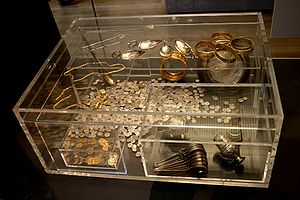 Display of Hoxne Hoard showing item placement when found via Wikipedia
From the coins in the hoard, archaeologists determined that the treasure was buried sometime after 406/7 A.D. The disintegration of the mighty Roman Empire was occurring around this time. The breakdown of Roman rule plunged Britain into anarchy which likely explains why these precious belongings were buried for safekeeping. Surely something dreadful must have happened to the family for the hoard was never retrieved.
Reference
______________________________
Original Post by THE BEADING GEM
Jewelry Making Tips - Jewelry Business Tips
The Hoxne Hoard : Body Chain Jewelry
 This rare and exquisite gold bejeweled body chain dates back to 5th century Britain. It once belonged to young girl or petite woman from a well-to-do family.
It definitely added refinement and social statement to what would otherwise be coarsely woven garments in those days. I think this jewelry style would still look stunning today on a plain evening gown with the right cut.
The body chain was part of the fabulous Hoxne (pronounced "Hoxon") Hoard, named after the village where it was found in Sussex, England in 1992.
It is the largest hoard, some 15,000 items, ever found from that era. This treasure trove netted the metal detectorist and the tenant farmer a total of £1.75 million which they shared equally. Several pieces are now on permanent display in the British Museum which purchased the hoard.
 Display of Hoxne Hoard showing item placement when found via Wikipedia
From the coins in the hoard, archaeologists determined that the treasure was buried sometime after 406/7 A.D. The disintegration of the mighty Roman Empire was occurring around this time. The breakdown of Roman rule plunged Britain into anarchy which likely explains why these precious belongings were buried for safekeeping. Surely something dreadful must have happened to the family for the hoard was never retrieved.
Photo : Courtesy of the British Museum
Reference
Original Post by THE BEADING GEM
Jewelry Making Tips - Jewelry Business Tips
Pearl Blay
archaeology
gemstone
historical
necklace
 Many beaders like to use two wires when stringing their necklaces to give them an extra dimension. The technique of using two or more strands in a design is definitely not new.
The above Sumerian Ur (circa 2500 BC) necklace using gold and lapis lazuli found in a royal grave (in modern day Iraq) uses two strands too. Lapis lazuli was so prized by the Sumerians that they considered it especially worthy for royalty. The lapis lazuli beads mimic the shape of the gold ones which adds the contrast element to this design.
Inspirational Lapis Lazuli Sumerian Necklace
 Many beaders like to use two wires when stringing their necklaces to give them an extra dimension. The technique of using two or more strands in a design is definitely not new.
The above Sumerian Ur (circa 2500 BC) necklace using gold and lapis lazuli found in a royal grave (in modern day Iraq) uses two strands too. Lapis lazuli was so prized by the Sumerians that they considered it especially worthy for royalty. The lapis lazuli beads mimic the shape of the gold ones which adds the contrast element to this design.

Lapis lazuli is mainly a mineral called lazurite. It can also contain sodalite (a blue gemstone), calcite (white bits) and pyrite (fool's gold). The best lapis are deep blue with flecks of pyrite. Sodalite, also a blue gemstone in its own right, does not have these golden flecks. It is a good gemstone alternative to the pricier lapis.
Lapis is a very attractive gemstone still in demand in modern day jewelry. It has a enduring quality as can be seen from the lapis pendant on the right. It appeals even today even though this one is a pendant made in Mesopotamia in circa 2900 BC!
References
Hugh Tait (1986). Jewelry : 7000 years. British Museum
Subscribe to:
Posts (Atom)