Pearl Blay
beader design
beadwork
gemstone
simulated gemstone
 Carol is a seasoned earring designer. Usually she designs just straight dangles. But in a burst of inspiration, she tried beadweaving instead at a recent workshop.
This design combine two types of gemstones and pink fibre optic cat's eye beads. She used two sizes of round hematite beads. The chunky two-holed gemstone in the middle are rose quartz beads. The half a disc shapes of the rose quartz not clear from the photo.
The threads were knotted and glued around a seed bead and hidden in the sterling silver clamshells. It really didn't matter what colour the Fireline thread was in this case but if you do mind the dark grey colour, Fireline now has the crystal/clear version. I just picked up some 8lb type from the fishing department of my local Walmart - all 114 metres worth for just over $20!
Beader Design #:286
___________________
The Beading Gem's Journal
Subscribe via RSS Via Email
Beadwoven Gemstone Earrings
 Carol is a seasoned earring designer. Usually she designs just straight dangles. But in a burst of inspiration, she tried beadweaving instead at a recent workshop.
This design combine two types of gemstones and pink fibre optic cat's eye beads. She used two sizes of round hematite beads. The chunky two-holed gemstone in the middle are rose quartz beads. The half a disc shapes of the rose quartz not clear from the photo.
The threads were knotted and glued around a seed bead and hidden in the sterling silver clamshells. It really didn't matter what colour the Fireline thread was in this case but if you do mind the dark grey colour, Fireline now has the crystal/clear version. I just picked up some 8lb type from the fishing department of my local Walmart - all 114 metres worth for just over $20!
Beader Design #:286
___________________
The Beading Gem's Journal
Subscribe
via RSS Via Email
Pearl Blay
beader design
earrings
gemstone
necklace
 When someone receives a jewelry gift, the lucky recipient might be stuck for additional pieces. Elizabeth was one such recipient of a hand made necklace which consisted of what looks like agate nuggets with an agate slab for the pendant - there were faint bands on the nuggets which is why I think they were agate.
She brought it with her at a recent workshop because she was on the look out for earrings to match. But not just any earrings, - she wanted small ones which suited her better. There were several carnelian beads in my collection so it took Elizabeth a while to decide on the cube ones. The variation of colour tones of the carnelians echoed those of her necklace. No one would have guessed that they were created at different times and by two different people.
Beader Design #: 285
___________________
The Beading Gem's Journal
Subscribe via RSS Via Email
Cube Carnelian Earrings to match!
 When someone receives a jewelry gift, the lucky recipient might be stuck for additional pieces. Elizabeth was one such recipient of a hand made necklace which consisted of what looks like agate nuggets with an agate slab for the pendant - there were faint bands on the nuggets which is why I think they were agate.
She brought it with her at a recent workshop because she was on the look out for earrings to match. But not just any earrings, - she wanted small ones which suited her better. There were several carnelian beads in my collection so it took Elizabeth a while to decide on the cube ones. The variation of colour tones of the carnelians echoed those of her necklace. No one would have guessed that they were created at different times and by two different people.
Beader Design #: 285
___________________
The Beading Gem's Journal
Subscribe
via RSS Via Email
Pearl Blay
feature designer
unusual jewelry
Gold Pan Jewelry
Feature Designer
When I select a feature designer for my blog, I am looking not just for inspirational jewelry but for something truly unique in both the design and in the designer. One has to see the passion for the craft and the person behind the creation.
Jimmy Pearce is the perfect example of the kind of artisan I seek. His speciality is natural gold nugget and sterling silver jewelry which he sells on his newly created website appropriately named Gold Pan Jewelry. He handcrafts his jewelry using traditional torch methods to solder as well as by wire wrapping and hammering techniques.


Jimmy is based in North Carolina and since he is retired from his flooring business, he can devote his full attention to learning all about jewelry and practising his craft. However, what is unusual about Jimmy is he is also a gold prospector - those nuggets he uses were found the hard, backbreaking way.
After finding his first nugget in his home state, gold fever struck. In 2003, he met his friend Mark Exeter in Alaska and together they staked some claims northwest of Fairbanks, about 60 miles from the Arctic Circle. Jimmy uses simple methods of locating gold ore. First he pans samples and counts the number of gold flakes he finds in that location. Then after testing several areas in this way, he returns to the spot which yielded the most flakes and begins collection either by sluicing, metal detecting or even diving underwater to locate those pockets of rare gold pieces. These "pickers" or nuggets are almost pure gold, between 20-23K.


It is mostly uncomfortable in prospecting season what with roughing it and tons of hungry mosquitoes which are conveniently out of focus in scenic photographs of the north. But there are also dangers to be faced. He and his partner bunk down in a converted metal motorcycle trailer ever since the grizzly bear raid on their tents in their first season. Even then, Jimmy had a terrifying experience when after hearing noises very early one morning, he opened the door of the trailer and came into eye-to-eye contact with a very large black bear (300-400 lbs) busy rummaging through their cook tent. Most black bears flee with shouting but this one charged. Fortunately the one shot Jimmy fired missed the bear but peppered him with loose gravel enough to scare him away. So both bear and man lived to forage another day! This is one designer who has actually risked his life for his craft!
Jimmy proudly considers himself a "green gold miner" because he uses the nuggets just as they are. There is no wasteful and destructive processing of the gold ore. Jimmy is definitely environmentally sensitive. The rocks he moves to get at nuggets are then carefully replaced before he moves on. Generally though, there is so little gold in the raw ore to begin with that mining companies go through tons of ore just to recover a little. In Marcy/Jewelry Geek's Gem Alert video on metalchasers, she talks about the No Dirty Gold Campaign which supports environmentally responsible and ethical mining practices.
You can check out Jimmy's metalchasers gallery which is where I found him! Thanks, Jimmy for the pictures and for sharing your hair-raising stories. We've hiked and camped extensively in the Canadian Rockies before but fortunately did not encounter any bears although we did see grizzly tracks once. I remember we had to suspend our food 15-20 feet from special poles (courtesy of Parks Canada) in bear country.
Good luck and stay safe with this summer's prospecting.
___________________
The Beading Gem's Journal
When I select a feature designer for my blog, I am looking not just for inspirational jewelry but for something truly unique in both the design and in the designer. One has to see the passion for the craft and the person behind the creation.
Jimmy Pearce is the perfect example of the kind of artisan I seek. His speciality is natural gold nugget and sterling silver jewelry which he sells on his newly created website appropriately named Gold Pan Jewelry. He handcrafts his jewelry using traditional torch methods to solder as well as by wire wrapping and hammering techniques.


Jimmy is based in North Carolina and since he is retired from his flooring business, he can devote his full attention to learning all about jewelry and practising his craft. However, what is unusual about Jimmy is he is also a gold prospector - those nuggets he uses were found the hard, backbreaking way.
After finding his first nugget in his home state, gold fever struck. In 2003, he met his friend Mark Exeter in Alaska and together they staked some claims northwest of Fairbanks, about 60 miles from the Arctic Circle. Jimmy uses simple methods of locating gold ore. First he pans samples and counts the number of gold flakes he finds in that location. Then after testing several areas in this way, he returns to the spot which yielded the most flakes and begins collection either by sluicing, metal detecting or even diving underwater to locate those pockets of rare gold pieces. These "pickers" or nuggets are almost pure gold, between 20-23K.


It is mostly uncomfortable in prospecting season what with roughing it and tons of hungry mosquitoes which are conveniently out of focus in scenic photographs of the north. But there are also dangers to be faced. He and his partner bunk down in a converted metal motorcycle trailer ever since the grizzly bear raid on their tents in their first season. Even then, Jimmy had a terrifying experience when after hearing noises very early one morning, he opened the door of the trailer and came into eye-to-eye contact with a very large black bear (300-400 lbs) busy rummaging through their cook tent. Most black bears flee with shouting but this one charged. Fortunately the one shot Jimmy fired missed the bear but peppered him with loose gravel enough to scare him away. So both bear and man lived to forage another day! This is one designer who has actually risked his life for his craft!
Jimmy proudly considers himself a "green gold miner" because he uses the nuggets just as they are. There is no wasteful and destructive processing of the gold ore. Jimmy is definitely environmentally sensitive. The rocks he moves to get at nuggets are then carefully replaced before he moves on. Generally though, there is so little gold in the raw ore to begin with that mining companies go through tons of ore just to recover a little. In Marcy/Jewelry Geek's Gem Alert video on metalchasers, she talks about the No Dirty Gold Campaign which supports environmentally responsible and ethical mining practices.
You can check out Jimmy's metalchasers gallery which is where I found him! Thanks, Jimmy for the pictures and for sharing your hair-raising stories. We've hiked and camped extensively in the Canadian Rockies before but fortunately did not encounter any bears although we did see grizzly tracks once. I remember we had to suspend our food 15-20 feet from special poles (courtesy of Parks Canada) in bear country.
Good luck and stay safe with this summer's prospecting.
___________________
The Beading Gem's Journal
Pearl Blay
beader design
bracelet
 Now this is seriously bold. When working with so many colours, it is easy to go seriously wrong. It takes a deft designer, one with confidence and flair for colours to pull off such a multi-coloured bracelet and wear it too.
Shapes not colours were the consistent elements of Susan's bracelet. Large bumpy lampwork beads were separated by cube millifiore and pale seed beads. If you have a gift for colour as Susan has, you won't need a colour wheel or study colour theory.
Susan is also a knitter and quilter and I wonder if she even knows about Kaffe Fassett, the San Francisco-born but London, England based designer famous for his use of many bold colours in his work - needlepoint, mosaic, patchwork, knitting and painting?
The Fire Mountain Gems Style team have also been at work with their 2008 Spring/Summer forecast . Thanks Susan, for that last tip!
Beader design #: 284
Be Bold with Colour : Part 3 of 3
More to enjoy:
Colour theory basics in jewelry designs
___________________
The Beading Gem's Journal
Subscribe via RSS Via Email
Bold Multi-Coloured Bracelet
 Now this is seriously bold. When working with so many colours, it is easy to go seriously wrong. It takes a deft designer, one with confidence and flair for colours to pull off such a multi-coloured bracelet and wear it too.
Shapes not colours were the consistent elements of Susan's bracelet. Large bumpy lampwork beads were separated by cube millifiore and pale seed beads. If you have a gift for colour as Susan has, you won't need a colour wheel or study colour theory.
Susan is also a knitter and quilter and I wonder if she even knows about Kaffe Fassett, the San Francisco-born but London, England based designer famous for his use of many bold colours in his work - needlepoint, mosaic, patchwork, knitting and painting?
The Fire Mountain Gems Style team have also been at work with their 2008 Spring/Summer forecast . Thanks Susan, for that last tip!
Beader design #: 284
Be Bold with Colour : Part 3 of 3
More to enjoy:
Colour theory basics in jewelry designs
___________________
The Beading Gem's Journal
Subscribe
via RSS Via Email
Pearl Blay
beader design
gemstone
necklace
 Many people pick blue as their favourite colour as it is a subdued, cool hue and restful on the eyes. However, there is one type of blue which fits the bold theme - cobalt blue. This necklace was designed by Robin. Simple yet elegant and sure to be a conversation piece. Only one bold colour was used and doesn't it stand out?
She started with the stunning faceted glass focal bead and teamed it with silver-lined bugle beads and round silver balls. The cobalt blue colour theme continued with dagger beads in two sizes and some seed beads.
Did you know cobalt blue was first used as a colour name as far back as 1777? Cobalt blue is made from cobalt (a kind of metal) salts and is used in the production of glass, inks, paints, varnishes and even blue concrete. The English watercolour artist, John Varley (1778-1842) suggested it as a cheaper bright blue alternative to ultramarine pigment for painting the sky. Before the advent of synthetic pigments, ultramarine was made from one of our favourite gemstones, lapis lazuli.
More to enjoy:
Lapis lazuli : The Twice Precious Gemstone. Lapis lazuli pigment was so expensive Rennaisance artists reserved it for painting the blue robes of the Virgin Mary.
Beader Design #: 283
Be Bold with Colour : Part 2 of 3
___________________
The Beading Gem's Journal
Subscribe via RSS Via Email
Bold Cobalt Blue Necklace
Many people pick blue as their favourite colour as it is a subdued, cool hue and restful on the eyes. However, there is one type of blue which fits the bold theme - cobalt blue. This necklace was designed by Robin. Simple yet elegant and sure to be a conversation piece. Only one bold colour was used and doesn't it stand out?She started with the stunning faceted glass focal bead and teamed it with silver-lined bugle beads and round silver balls. The cobalt blue colour theme continued with dagger beads in two sizes and some seed beads.
Did you know cobalt blue was first used as a colour name as far back as 1777? Cobalt blue is made from cobalt (a kind of metal) salts and is used in the production of glass, inks, paints, varnishes and even blue concrete. The English watercolour artist, John Varley (1778-1842) suggested it as a cheaper bright blue alternative to ultramarine pigment for painting the sky. Before the advent of synthetic pigments, ultramarine was made from one of our favourite gemstones, lapis lazuli.
More to enjoy:
Lapis lazuli : The Twice Precious Gemstone. Lapis lazuli pigment was so expensive Rennaisance artists reserved it for painting the blue robes of the Virgin Mary.
Beader Design #: 283
Be Bold with Colour : Part 2 of 3
___________________
The Beading Gem's Journal
Subscribe
via RSS Via Email
Pearl Blay
beader design
earrings
 Many women prefer very subdued jewelry but really, the one sure way to catch people's eyes is to wear striking colours. Or conversely, use such jewelry to "punch up" a neutral outfit.
This week's mini series : Be Bold with Colour will feature three beader creations where the designers were not afraid to design with strong colours....and more importantly, wear them!
Brenda used orangish-gold crystals coupled with orange-red beads to great effect. The large gold foil bead of the left pair of earrings leads down to smaller dangles whereas the right pair were simple dangles. Red and orange are both warm colours - the contrast in this case is one is darker toned than the other. The foil bead earrings also had the metallic elements like the pewter beads and the stripped feature of the foil beads for variation on this hot theme. It sure warms the heart especially when there are still several inches of snow outside.
Beader Design #: 282
Be Bold with Colour : Part 1 of 3
___________________
The Beading Gem's Journal
Hot,Hot Earrings!
 Many women prefer very subdued jewelry but really, the one sure way to catch people's eyes is to wear striking colours. Or conversely, use such jewelry to "punch up" a neutral outfit.
This week's mini series : Be Bold with Colour will feature three beader creations where the designers were not afraid to design with strong colours....and more importantly, wear them!
Brenda used orangish-gold crystals coupled with orange-red beads to great effect. The large gold foil bead of the left pair of earrings leads down to smaller dangles whereas the right pair were simple dangles. Red and orange are both warm colours - the contrast in this case is one is darker toned than the other. The foil bead earrings also had the metallic elements like the pewter beads and the stripped feature of the foil beads for variation on this hot theme. It sure warms the heart especially when there are still several inches of snow outside.
Beader Design #: 282
Be Bold with Colour : Part 1 of 3
___________________
The Beading Gem's Journal
Pearl Blay
biography
gemstone
historical
movie

When I started this very different kind of jewelry blog, I did not know I would one day be writing about a Bollywood movie! Goes to show there is always a first time.
Jodhaa Akbar by the Academy Award nominated writer-director, Ashutosh Gowariker ("Lagaan" in 2001) is epic in scope as well as length (over 3 hours). There was much excitement and anticipation leading up to its release last week. It caught my attention because of two things - the fabulous jewelry and costume design and it was about Akbar (1542-1605), the greatest of all the Mughal (Moghul) Emperors of India and the Rajput princess he married.

I watched the movie trailer and was amazed at the wonderful jewelry created by a team of 80 stylists from Tanishq, a leading Indian jewelry manufacturer. What was more astounding was the use of real gemstones and gold for the film. Considerable research went into creating authentic period pieces. Besides the pearls, rubies and emeralds, unfaceted diamonds were used - Indian craftsmen of that era produced mostly polished diamond cabochons.
The Mughal Emperors were descended from the Mongol leaders, Tamburlaine and Genghis Khan. The Mongols were fearsome warriors - one custom was to build mortared pillars made out of the heads of their vanquished enemies. The first six Mughals were powerful and impossibly wealthy rulers of much of India and parts of Afghanistan in the 16th and 17th centuries. Noted for their great military and administrative skills, they were also staunch patrons of the arts and sciences - they left behind a wonderful legacy of Mughal architecture and a sophisticated system of government later adopted by the British.
 Like all the Mughals, the third Emperor, Akbar, was Muslim. He earned the title "Akbar the Great" because his reign was marked not just by his military prowess and the growth of his realm, but for his extraordinary interest in and tolerance of all religions. He even founded a new religion, Dīn-i Ilāhī based on the best elements of several religions in an effort to unite his subjects. He abolished, at a cost to his treasury, taxes imposed upon Hindu pilgrims and "non-believers" and welcomed Hindus into his civil service. He realized the stability of his nation was dependent on the harmonious coexistence of the two main religious groups.
The movie is about the romance between him and a Hindu Rajput princess along the lines of "as he conquered lands, he also had to conquer her heart." He was not the first Muslim ruler to marry a Hindu woman but he was the first to allow her to practice her own faith if she so wished. It was a shrewd marital alliance for the Rajputs were fierce Indian warriors - it was best to have them on his side.
Like all movies, this one was meant to entertain, not deliver historical accuracies. The filmmakers cheerfully acknowledge Jodhaa wasn't really her name. Nor is it clear if the heroine was supposed to be the first Rajput princess he married, and mother of his heir, Jahangir. Akbar actually married a few Rajput princesses - he really made sure they were on his side! His harem consisted of over 300 wives, many of whom he married for purely political reasons. Was the love truly grand like that of his grandson, Shah Jahan, who built the Taj Mahal for his beloved? Alas no, according to the historian and author, Bamber Gascoigne (see reference below), Akbar did have some preferences but only his mother received his strongest affection.
Still, because of the lavish production and all that jewelry, both masculine and feminine, I will be looking for this movie in my local video store when it comes out. This Indian production is free of nudity, profanity, and outright goriness typical of today's Hollywood epic fare. Even elephants shown on the movie looked as if they were having a good time on the set earning their sweet treats - not at all like the famed Indian fighting elephants long ago which so terrified invading armies. I won't mind the English subtitles either for I am better off than Indian audiences who must understand both the Urdu spoken by Akbar and pure Hindi spoken by the princess.
It will be the first Bollywood movie I will rent/see. As I said, there is always a first time for everything.
Update : I eventually saw it on Netflix. It was marvelous! Highly recommended.
More to enjoy :
The Jewels and Jewelry Obsession of Shah Jahan Akbar's grandson had a major jewelry obsession - his hoard was so vast, cataloguing it all would have taken years.
Tammy's Indian Style Bracelet In the trailer, there is one scene where Jodhaa wears what looks like a pearl and ruby bracelet with finger extension. Tammy is one beader who created her own based on this style of jewelry.
References
Original Post by THE BEADING GEM
Jewelry Making Tips - Jewelry Business Tips
The Jewelry of an Epic Bollywood Movie

When I started this very different kind of jewelry blog, I did not know I would one day be writing about a Bollywood movie! Goes to show there is always a first time.
Jodhaa Akbar by the Academy Award nominated writer-director, Ashutosh Gowariker ("Lagaan" in 2001) is epic in scope as well as length (over 3 hours). There was much excitement and anticipation leading up to its release last week. It caught my attention because of two things - the fabulous jewelry and costume design and it was about Akbar (1542-1605), the greatest of all the Mughal (Moghul) Emperors of India and the Rajput princess he married.

I watched the movie trailer and was amazed at the wonderful jewelry created by a team of 80 stylists from Tanishq, a leading Indian jewelry manufacturer. What was more astounding was the use of real gemstones and gold for the film. Considerable research went into creating authentic period pieces. Besides the pearls, rubies and emeralds, unfaceted diamonds were used - Indian craftsmen of that era produced mostly polished diamond cabochons.
The Mughal Emperors were descended from the Mongol leaders, Tamburlaine and Genghis Khan. The Mongols were fearsome warriors - one custom was to build mortared pillars made out of the heads of their vanquished enemies. The first six Mughals were powerful and impossibly wealthy rulers of much of India and parts of Afghanistan in the 16th and 17th centuries. Noted for their great military and administrative skills, they were also staunch patrons of the arts and sciences - they left behind a wonderful legacy of Mughal architecture and a sophisticated system of government later adopted by the British.

The movie is about the romance between him and a Hindu Rajput princess along the lines of "as he conquered lands, he also had to conquer her heart." He was not the first Muslim ruler to marry a Hindu woman but he was the first to allow her to practice her own faith if she so wished. It was a shrewd marital alliance for the Rajputs were fierce Indian warriors - it was best to have them on his side.
Like all movies, this one was meant to entertain, not deliver historical accuracies. The filmmakers cheerfully acknowledge Jodhaa wasn't really her name. Nor is it clear if the heroine was supposed to be the first Rajput princess he married, and mother of his heir, Jahangir. Akbar actually married a few Rajput princesses - he really made sure they were on his side! His harem consisted of over 300 wives, many of whom he married for purely political reasons. Was the love truly grand like that of his grandson, Shah Jahan, who built the Taj Mahal for his beloved? Alas no, according to the historian and author, Bamber Gascoigne (see reference below), Akbar did have some preferences but only his mother received his strongest affection.
Still, because of the lavish production and all that jewelry, both masculine and feminine, I will be looking for this movie in my local video store when it comes out. This Indian production is free of nudity, profanity, and outright goriness typical of today's Hollywood epic fare. Even elephants shown on the movie looked as if they were having a good time on the set earning their sweet treats - not at all like the famed Indian fighting elephants long ago which so terrified invading armies. I won't mind the English subtitles either for I am better off than Indian audiences who must understand both the Urdu spoken by Akbar and pure Hindi spoken by the princess.
It will be the first Bollywood movie I will rent/see. As I said, there is always a first time for everything.
Update : I eventually saw it on Netflix. It was marvelous! Highly recommended.
More to enjoy :
The Jewels and Jewelry Obsession of Shah Jahan Akbar's grandson had a major jewelry obsession - his hoard was so vast, cataloguing it all would have taken years.
Tammy's Indian Style Bracelet In the trailer, there is one scene where Jodhaa wears what looks like a pearl and ruby bracelet with finger extension. Tammy is one beader who created her own based on this style of jewelry.
References
- Via Jewels Stones and Future Movies
- BBC's The Mughal Empire
- Bamber Gascoigne (2002). The Great Moghuls : India's Most Flamboyant Rulers. Constable and Robinson Ltd, London.
Original Post by THE BEADING GEM
Jewelry Making Tips - Jewelry Business Tips
Pearl Blay
beader design
gemstone
necklace
 Ok. I confess one of the advantages of teaching beading design is what beginners sometimes teach ME.
Helen is one who did with her brecciated jasper and rhodonite necklace. The lovely reddish hues of brecciated jasper make this gemstone the only brown coloured one I can wear. Other earthy coloured gemstones just make me look insipid. However, I would never ever have considered combining it with pink rhodonite as Helen did.
Her pretty necklace sported round brecciated jasper gemstones in two sizes whilst the rhodonite was rice shaped. If you look closely at brecciated jasper, it has cracks which are filled in gray material. When the cementing material is opal, the gemstone is then called opal jasper.
Take note that sometimes the name of the jasper denotes where it comes from. Stone Canyon jasper is brecciated jasper from - no prizes for guessing - Stone Canyon near San Miguel in California. For more jasper names, check out the list on this website from minerals.net.
Beader Design #: 281
_________________
The Beading Gem's Journal
Brecciated Jasper and Rhodonite Necklace
 Ok. I confess one of the advantages of teaching beading design is what beginners sometimes teach ME.
Helen is one who did with her brecciated jasper and rhodonite necklace. The lovely reddish hues of brecciated jasper make this gemstone the only brown coloured one I can wear. Other earthy coloured gemstones just make me look insipid. However, I would never ever have considered combining it with pink rhodonite as Helen did.
Her pretty necklace sported round brecciated jasper gemstones in two sizes whilst the rhodonite was rice shaped. If you look closely at brecciated jasper, it has cracks which are filled in gray material. When the cementing material is opal, the gemstone is then called opal jasper.
Take note that sometimes the name of the jasper denotes where it comes from. Stone Canyon jasper is brecciated jasper from - no prizes for guessing - Stone Canyon near San Miguel in California. For more jasper names, check out the list on this website from minerals.net.
Beader Design #: 281
_________________
The Beading Gem's Journal
Pearl Blay
beadwork
bridal
feature designer
hair jewelry


Feature Designer
Bridal jewelry is quite different from other types of adornment. Firstly, bridal jewelry is all about glamour for a single special day. Designing such jewelry also confines the designer to a limited colour palette. A bride is the focus of attention on her special day so she wants to look her best and I dare say, is willing to pay for it.
Lonni Tanksley of Philadelphia, USA is one such specialist artisan who demonstrates considerable artistic expression in her creations. Her early passion for dance (ballet) and theatre plus a music degree has given her the edge on the "drama" part of bridal adornment.
Lonni's Bridal Headpiece and Assessories line took a while to get going. Her initial efforts with beaded flower jewelry got her nowhere until she crafted a bridal looking comb and choker which was her eureka moment. It is her combs which caught my eye. These beautiful beaded confections are perfect for updos worn by brides. Not everyone is enamoured of tiaras, full headpieces and veils.
She crafted the "Wildflowers" (left) comb from Miyuki Delica beads, complete with a crystal bow beneath. The butterfly and delicate wire stalks are lovely touches. Calla lilies are often carried by brides so I was equally charmed by her take on this classic wedding flower in the comb on the right. She used not just Miyuki Delica beads but also freshwater stick pearls in cascades of Swarovski crystals.
Her main clientele are the upscale shops and bridal salons in her home city. But you can see some of her designs on her Etsy site. Photos with kind permission from Lonni.
Beautiful bridal jewelry from other parts of the world :
The Sanggul Lintang of Traditional Malay Brides These elaborate headpieces are worn by Malay brides from South East Asia along with their traditional dresses.
Indian Bridal Jewelry The unique pieces are made from gold and real gemstones and adorn Indian brides literally from head to foot.
___________________
The Beading Gem's Journal
Bridal Creations by Lonni


Feature Designer
Bridal jewelry is quite different from other types of adornment. Firstly, bridal jewelry is all about glamour for a single special day. Designing such jewelry also confines the designer to a limited colour palette. A bride is the focus of attention on her special day so she wants to look her best and I dare say, is willing to pay for it.
Lonni Tanksley of Philadelphia, USA is one such specialist artisan who demonstrates considerable artistic expression in her creations. Her early passion for dance (ballet) and theatre plus a music degree has given her the edge on the "drama" part of bridal adornment.
Lonni's Bridal Headpiece and Assessories line took a while to get going. Her initial efforts with beaded flower jewelry got her nowhere until she crafted a bridal looking comb and choker which was her eureka moment. It is her combs which caught my eye. These beautiful beaded confections are perfect for updos worn by brides. Not everyone is enamoured of tiaras, full headpieces and veils.
She crafted the "Wildflowers" (left) comb from Miyuki Delica beads, complete with a crystal bow beneath. The butterfly and delicate wire stalks are lovely touches. Calla lilies are often carried by brides so I was equally charmed by her take on this classic wedding flower in the comb on the right. She used not just Miyuki Delica beads but also freshwater stick pearls in cascades of Swarovski crystals.
Her main clientele are the upscale shops and bridal salons in her home city. But you can see some of her designs on her Etsy site. Photos with kind permission from Lonni.
Beautiful bridal jewelry from other parts of the world :
The Sanggul Lintang of Traditional Malay Brides These elaborate headpieces are worn by Malay brides from South East Asia along with their traditional dresses.
Indian Bridal Jewelry The unique pieces are made from gold and real gemstones and adorn Indian brides literally from head to foot.
___________________
The Beading Gem's Journal
Pearl Blay
beader design
beadinggem designs
earrings
Pearl's Designs


Lee rather liked my purple funky earrings on the left which I called "Comet" for obvious reasons. She wanted to incorporate the spiral elements in her design. It got a little tricky as she couldn't quite get the design to the way she wanted. But patience always pays off in the end. She did get those spirals into her design at the bottom, forgoing the long tail as it would have made the earrings too long for her taste.
The astronomy theme also came about from the spiral bound beads which surely reminds one of Saturn's rings (sort of). Saturn is my favourite planet because it is beautiful to look at. At least Saturn is still a planet although the Solar System count is now down to eight from nine. A couple of years ago, my teenaged kids were dismayed when the International Astronomical Union voted to remove Pluto's planetary status. One of them remarked with disgust, "Well, grade 2 was total a waste of time!"
They weren't alone in their reaction to Pluto's downgrade to dwarf planet. Many adults too were taken aback. But it had to be for with better telescopes more objects the size of Pluto (one is even larger) have been discovered. So stricter definitions of planets were needed otherwise textbooks would be listing 50 or more planets in our Solar System.
Beader Design# : 279-280
Reference
BBC's Pluto loses status as a planet
___________________
The Beading Gem's Journal
Of Planets and Comets Earrings


Lee rather liked my purple funky earrings on the left which I called "Comet" for obvious reasons. She wanted to incorporate the spiral elements in her design. It got a little tricky as she couldn't quite get the design to the way she wanted. But patience always pays off in the end. She did get those spirals into her design at the bottom, forgoing the long tail as it would have made the earrings too long for her taste.
The astronomy theme also came about from the spiral bound beads which surely reminds one of Saturn's rings (sort of). Saturn is my favourite planet because it is beautiful to look at. At least Saturn is still a planet although the Solar System count is now down to eight from nine. A couple of years ago, my teenaged kids were dismayed when the International Astronomical Union voted to remove Pluto's planetary status. One of them remarked with disgust, "Well, grade 2 was total a waste of time!"
They weren't alone in their reaction to Pluto's downgrade to dwarf planet. Many adults too were taken aback. But it had to be for with better telescopes more objects the size of Pluto (one is even larger) have been discovered. So stricter definitions of planets were needed otherwise textbooks would be listing 50 or more planets in our Solar System.
Beader Design# : 279-280
Reference
BBC's Pluto loses status as a planet
___________________
The Beading Gem's Journal
Pearl Blay
blog
 I am always very happy to see comments on my blog posts - if anything, it proves somebody somewhere actually reads them! And is moved enough to drop me a few lines. But one of yesterday's comments came with a lovely surprise - a You Make My Day Award from Capitola Girl who really keeps her pulse on the beading scene over at her blog. Capitola Girl hails from sunny California - even her blog wrapper is that happy colour!
I not only enjoy writing this blog but I also love reading other blogs too. So here are five blogs that make MY day (in no particular order) :
A Bead A Day. BetteJo started her blog to promote her jewelry line but confesses blogging has now overtaken the jewelry selling although she occasionally sells the jewelry because of her engaging blog. I enjoy all her posts - some poignant, some downright funny, some thought provoking - in short, it's about life. BetteJo is also a cat lover - she owns four and they sometimes star in her posts. She keeps tabs on an astounding 70+ blogs so I count myself very lucky when she finds the time to comment on my blog.
Diana Norman Designs. Diana, from New York State, is a relatively new blogger but she is a seasoned jewelry artisan specialising in real flower jewelry. Diana and I share many traits including a curiousity to know STUFF. So I was pleased when she agreed to be a guest blogger here. I enjoy her blog because she tries different things out on her blog - a new combination "Lucky Leaf with Braided Copper" was her most recent entry. She also touches on the kind of informative articles I thrive on.
Voice from Jamaica. LadyRoots is a passionate beadwork artist. Her blog was one of my lucky finds. Not only am I treated to her beadwork pictures but LadyRoots also lets readers see her sense of humour. She lives in Jamaica and recently posted pictures of her lovely island home after someone wrote in to ask if her blog was indeed an invitation to stop and visit, why doesn't she show where she lives. Now I know, near a place called Alligator Pond!
Marika's Artisan Handmade Silver Jewelry. Marika from Cyprus was another of my fortunate stumbles. She makes lovely wire and chain maille jewelry but most of all her blog does indeed log her journey and growth as a jewelry artisan and in her marketing. As she markets her jewelry and supplies to her shops in both Etsy and Dwanda, her recent post show the difference between what sells in North America vs Europe, at least for her.
So you wannabee a Domestik Goddess? Jen/domestika is a Canadian writer and editor who loves to write about crafts, home decor and lifestyle topics with a nod to thrift and creativity. She sometimes touches on jewelry topics like her recent "Man, That's One Ugly Necklace". Her incredible finds on all the things you could get for your home plus her great writing style makes this blog a treat.
***********************************************************************************
Pass the award on, here are the details :
1. Write a post with links to 5 blogs that make your day.
2. Acknowledge the post of the award giver.
3. Display the You Make My Day Award logo.
4. Tell the award winners that they have won by commenting on their blogs with the news.
***********************************************************************************
___________________
The Beading Gem's Journal
Subscribe via RSS Via Email
You Make My Day Award
 I am always very happy to see comments on my blog posts - if anything, it proves somebody somewhere actually reads them! And is moved enough to drop me a few lines. But one of yesterday's comments came with a lovely surprise - a You Make My Day Award from Capitola Girl who really keeps her pulse on the beading scene over at her blog. Capitola Girl hails from sunny California - even her blog wrapper is that happy colour!
I not only enjoy writing this blog but I also love reading other blogs too. So here are five blogs that make MY day (in no particular order) :
A Bead A Day. BetteJo started her blog to promote her jewelry line but confesses blogging has now overtaken the jewelry selling although she occasionally sells the jewelry because of her engaging blog. I enjoy all her posts - some poignant, some downright funny, some thought provoking - in short, it's about life. BetteJo is also a cat lover - she owns four and they sometimes star in her posts. She keeps tabs on an astounding 70+ blogs so I count myself very lucky when she finds the time to comment on my blog.
Diana Norman Designs. Diana, from New York State, is a relatively new blogger but she is a seasoned jewelry artisan specialising in real flower jewelry. Diana and I share many traits including a curiousity to know STUFF. So I was pleased when she agreed to be a guest blogger here. I enjoy her blog because she tries different things out on her blog - a new combination "Lucky Leaf with Braided Copper" was her most recent entry. She also touches on the kind of informative articles I thrive on.
Voice from Jamaica. LadyRoots is a passionate beadwork artist. Her blog was one of my lucky finds. Not only am I treated to her beadwork pictures but LadyRoots also lets readers see her sense of humour. She lives in Jamaica and recently posted pictures of her lovely island home after someone wrote in to ask if her blog was indeed an invitation to stop and visit, why doesn't she show where she lives. Now I know, near a place called Alligator Pond!
Marika's Artisan Handmade Silver Jewelry. Marika from Cyprus was another of my fortunate stumbles. She makes lovely wire and chain maille jewelry but most of all her blog does indeed log her journey and growth as a jewelry artisan and in her marketing. As she markets her jewelry and supplies to her shops in both Etsy and Dwanda, her recent post show the difference between what sells in North America vs Europe, at least for her.
So you wannabee a Domestik Goddess? Jen/domestika is a Canadian writer and editor who loves to write about crafts, home decor and lifestyle topics with a nod to thrift and creativity. She sometimes touches on jewelry topics like her recent "Man, That's One Ugly Necklace". Her incredible finds on all the things you could get for your home plus her great writing style makes this blog a treat.
***********************************************************************************
Pass the award on, here are the details :
1. Write a post with links to 5 blogs that make your day.
2. Acknowledge the post of the award giver.
3. Display the You Make My Day Award logo.
4. Tell the award winners that they have won by commenting on their blogs with the news.
***********************************************************************************
___________________
The Beading Gem's Journal
Subscribe
via RSS Via Email
Pearl Blay
beader design
bracelet
gem facts and fun
gemstone
 Susan adores gemtones and is usually on the hunt for more for her bracelet collection. She bought the yellow turquoise coins and the lewisonite chips at a jewelry store just outside Halifax. The soft buttery yellow-green of the lewisonite was the perfect match for the mottled hues of the yellow turquoise.
Susan alerted me to the fact that lewisonite is a new gemstone. It was discovered by Monty Lewis, a lapidary from New Brunswick and it is obviously named after him. He found it in Cape Breton Highlands, a region in the north of my home province, Nova Scotia. Cape Breton is a lovely place, reminiscient of the Scottish Highlands so much so that Scottish born Alexander Graham Bell, the inventor of the telephone, built a summer home in Baddeck and retired there. The house is still owned by his descendants.
According to the Melmont Creations website, lewisonite was formally introduced as a new gemstone at the 2006 Tuscon Bead Show by the US gem dealer, Stephen Mauldin and Co. It is generating interest due to its colour ranges and durability. Inuit carvers are also using this gemstone for their creations.
I was bemused the Melmont Creations website identified the location of the gemstone's discovery as a mountain "in a remote part of Canada"! The Cape Breton Highlands is but a 4-5 hr drive north of the city of Halifax where I am located. To Canadians, remote would be say, Nunavut way up north in the Arctic!! It all depends on your reference point.
Beader Design #: 278
References
New Brunswick Telegraph Journal article Published February 2, 2008
Melmont Creations.com
___________________
The Beading Gem's Journal
Subscribe via RSS Via Email
Yellow Turquoise and Lewisonite Bracelet
 Susan adores gemtones and is usually on the hunt for more for her bracelet collection. She bought the yellow turquoise coins and the lewisonite chips at a jewelry store just outside Halifax. The soft buttery yellow-green of the lewisonite was the perfect match for the mottled hues of the yellow turquoise.
Susan alerted me to the fact that lewisonite is a new gemstone. It was discovered by Monty Lewis, a lapidary from New Brunswick and it is obviously named after him. He found it in Cape Breton Highlands, a region in the north of my home province, Nova Scotia. Cape Breton is a lovely place, reminiscient of the Scottish Highlands so much so that Scottish born Alexander Graham Bell, the inventor of the telephone, built a summer home in Baddeck and retired there. The house is still owned by his descendants.
According to the Melmont Creations website, lewisonite was formally introduced as a new gemstone at the 2006 Tuscon Bead Show by the US gem dealer, Stephen Mauldin and Co. It is generating interest due to its colour ranges and durability. Inuit carvers are also using this gemstone for their creations.
I was bemused the Melmont Creations website identified the location of the gemstone's discovery as a mountain "in a remote part of Canada"! The Cape Breton Highlands is but a 4-5 hr drive north of the city of Halifax where I am located. To Canadians, remote would be say, Nunavut way up north in the Arctic!! It all depends on your reference point.
Beader Design #: 278
References
New Brunswick Telegraph Journal article Published February 2, 2008
Melmont Creations.com
___________________
The Beading Gem's Journal
Subscribe
via RSS Via Email
Pearl Blay
beader design
gemstone
necklace
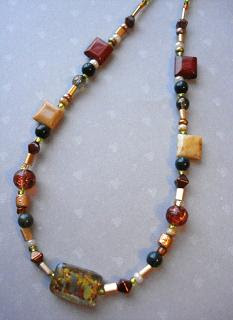 Noreen was so pleased with her creation she was convinced she sounded like a little girl saying " I really like my necklace!" And that is exactly what I love to hear. When someone designs their own jewelry, you KNOW they are going to love it.
Noreen invested a whole afternoon working away at this design. The eclectic choices of beads in natural colours appealed to her taste. There were some gemstones too in her design which included the doubled holed flat square jasper gemstones which were strung only through their top holes. The large gold foil focal bead with artistic swirls of colour served as an anchor to this earthy toned necklace.
Beader Design #: 278
___________________
The Beading Gem's Journal
Subscribe via RSS Via Email
Eclectic gemstone necklace
 Noreen was so pleased with her creation she was convinced she sounded like a little girl saying " I really like my necklace!" And that is exactly what I love to hear. When someone designs their own jewelry, you KNOW they are going to love it.
Noreen invested a whole afternoon working away at this design. The eclectic choices of beads in natural colours appealed to her taste. There were some gemstones too in her design which included the doubled holed flat square jasper gemstones which were strung only through their top holes. The large gold foil focal bead with artistic swirls of colour served as an anchor to this earthy toned necklace.
Beader Design #: 278
___________________
The Beading Gem's Journal
Subscribe
via RSS Via Email
Pearl Blay
gem facts and fun
gemstone
In the footsteps of a pearl dealer
I first came across an eBay merchant, a father and daughter team called Pearl Emporium about a couple of years ago. I am not affliated with them in any way except as a satisfied customer - nice pearls at great prices! Nor did they approach me. But when I approached them with my idea for a blog post, they were most prompt and gracious in their reply - believe me, not many merchants would bother.
Dad is based in the Philippines where he makes frequent buying trips to China for freshwater pearls. Charlotte is his daughter who is based in Florida where mainly pearls, some gemstones and glass beads are shipped to for sale in North America.
Over the years, I have read virtually every one of Dad's newsletters and his informative eBay guides. The email newsletter subscriptions I receive tell of the ups and downs of doing business in different countries. I remember the time Dad struggled trying to do business painfully slowly on dial up for a while when the major internet cables he relied on were damaged in a Taiwanese earthquake. Or his chagrin at the two week absolute shutdown of all business dealings over Chinese New Year - not even a teeny-weeny phone call! I also rejoiced for him when he wrote Charlotte had safely delivered her child.
But most of all, I've enjoyed and learnt from his first hand accounts of the pearl industry in China. So often, we jewelry artisans have no idea where our materials come from or about the people who produce it.


Dad wrote in one of his ebay guides the majority of working pearl farms in the Zhejiang Province, where nearly 90% of the world's freshwater pearls are produced, are actually old rice fields simply made about 1- 2 metres deeper like the one above left. He has come across a few farms in beautiful surroundings but they are the exception rather than the rule. Beautiful pearls take a long time to produce - the longer, the better - the best pearls are harvested after 3.5 - 7 years.
In another guide, he explains a single oyster could contain anything from one to one hundred pearls! The middle picture of a freshwater oyster above shows several on both shell halves. The women in the picture on the right are harvesting the pearls from oysters that have been out of the water for three days. The workers are older women because none of the younger generation want a stinking job like this!


The pearls then go through a crude drum-like agitator where the remaining tissue is removed. Meanwhile the women still sit amongst the now huge mounds of leftover shells for they have to cull the mabe or blister pearls. The umbrellas must provide them with some shelter from sun or rain but they do nothing for the stench! The leftover shells then go for cutting into the mother of pearl beads we all love so well.


The pearls are then sorted and then strung by the women shown above. Notice how thick their coats are? Dad said he has never seen a single heater in some 400 farms he has visited even in the dead of winter!
What's the latest about the pearl industry in China? Dad says with the rising value of the yuan, a 20% increase in wages, a diesel fuel shortage and increasing government regulations, expect pearl prices to rise in the future. That's true for other goods coming out of China like toys. The decreased value of the US dollar and rising fuel costs are also factors. He also predicts trouble brewing ahead with the government closure of the old Zhejiang Public Pearl Market to a new one with higher rentals which is deeply resented.
Pictures with kind permission from Dad. Keep those guides and newsletters coming!!
UPDATE : This store is no longer in operation on eBAY.
___________________
The Beading Gem's Journal
Dad is based in the Philippines where he makes frequent buying trips to China for freshwater pearls. Charlotte is his daughter who is based in Florida where mainly pearls, some gemstones and glass beads are shipped to for sale in North America.
Over the years, I have read virtually every one of Dad's newsletters and his informative eBay guides. The email newsletter subscriptions I receive tell of the ups and downs of doing business in different countries. I remember the time Dad struggled trying to do business painfully slowly on dial up for a while when the major internet cables he relied on were damaged in a Taiwanese earthquake. Or his chagrin at the two week absolute shutdown of all business dealings over Chinese New Year - not even a teeny-weeny phone call! I also rejoiced for him when he wrote Charlotte had safely delivered her child.
But most of all, I've enjoyed and learnt from his first hand accounts of the pearl industry in China. So often, we jewelry artisans have no idea where our materials come from or about the people who produce it.


Dad wrote in one of his ebay guides the majority of working pearl farms in the Zhejiang Province, where nearly 90% of the world's freshwater pearls are produced, are actually old rice fields simply made about 1- 2 metres deeper like the one above left. He has come across a few farms in beautiful surroundings but they are the exception rather than the rule. Beautiful pearls take a long time to produce - the longer, the better - the best pearls are harvested after 3.5 - 7 years.
In another guide, he explains a single oyster could contain anything from one to one hundred pearls! The middle picture of a freshwater oyster above shows several on both shell halves. The women in the picture on the right are harvesting the pearls from oysters that have been out of the water for three days. The workers are older women because none of the younger generation want a stinking job like this!


The pearls then go through a crude drum-like agitator where the remaining tissue is removed. Meanwhile the women still sit amongst the now huge mounds of leftover shells for they have to cull the mabe or blister pearls. The umbrellas must provide them with some shelter from sun or rain but they do nothing for the stench! The leftover shells then go for cutting into the mother of pearl beads we all love so well.


The pearls are then sorted and then strung by the women shown above. Notice how thick their coats are? Dad said he has never seen a single heater in some 400 farms he has visited even in the dead of winter!
What's the latest about the pearl industry in China? Dad says with the rising value of the yuan, a 20% increase in wages, a diesel fuel shortage and increasing government regulations, expect pearl prices to rise in the future. That's true for other goods coming out of China like toys. The decreased value of the US dollar and rising fuel costs are also factors. He also predicts trouble brewing ahead with the government closure of the old Zhejiang Public Pearl Market to a new one with higher rentals which is deeply resented.
Pictures with kind permission from Dad. Keep those guides and newsletters coming!!
UPDATE : This store is no longer in operation on eBAY.
___________________
The Beading Gem's Journal
Pearl Blay
beader design
necklace
 I have come to the conclusion the number of ways to make a pendant for a necklace is inexhaustible. Just when I think I've seen all the permutations possible, something else turns up - like Sharon's creation here.
This is Sharon's second ever attempt at designing. She saw the advantages of using a four holed crystal adorned metal bead over a two-holed one. So for her bare wire necklace, she did a little beadweaving using seed beads and additional metal beads. The overall effect was pretty and delicate.
Beader Design #:277
___________________
The Beading Gem's Journal
Wire and Crystal Pendant Necklace
 I have come to the conclusion the number of ways to make a pendant for a necklace is inexhaustible. Just when I think I've seen all the permutations possible, something else turns up - like Sharon's creation here.
This is Sharon's second ever attempt at designing. She saw the advantages of using a four holed crystal adorned metal bead over a two-holed one. So for her bare wire necklace, she did a little beadweaving using seed beads and additional metal beads. The overall effect was pretty and delicate.
Beader Design #:277
___________________
The Beading Gem's Journal
Pearl Blay
beader design
earrings
Mother's Day
seasonal
Valentine's Day


Valentine's day started off as a lovers' day but it has become a general love day. Many people exchange gifts, cards and sentiments with those they care about, not just to their sweethearts.
Pat made all these earrings at a recent workshop. She was definitely on a roll! You could say they were mother and daughter designs for she made them for herself and her daughter. When I asked her which were for whom, she said she hadn't decided yet but the heart ones were probably for her daughter whom she clearly loved.
I hope hearts and love filled your day today.
Beader design #: 276
___________________
The Beading Gem's Journal
Subscribe via RSS Via Email
Happy Heart Day!


Valentine's day started off as a lovers' day but it has become a general love day. Many people exchange gifts, cards and sentiments with those they care about, not just to their sweethearts.
Pat made all these earrings at a recent workshop. She was definitely on a roll! You could say they were mother and daughter designs for she made them for herself and her daughter. When I asked her which were for whom, she said she hadn't decided yet but the heart ones were probably for her daughter whom she clearly loved.
I hope hearts and love filled your day today.
Beader design #: 276
___________________
The Beading Gem's Journal
Subscribe
via RSS Via Email
Pearl Blay
bracelet
chain maille
feature designer
tutorial
video tutorial


Marika is an accomplished wire and chain maille artisan from Cyprus whom I have featured before with her delightful chain maille fuschia flower earrings. She documents her journey as artisan on her blog. I enjoy reading about her various experiments.
Not long ago, she decided to address the issue of why chain maille jewelry costs so much more after fielding such questions from people who have absolutely no idea of the labour involved. So she wrote and photo-illustrated this wonderful blog post on how she made the above silver byzantine bracelet with a lampwork bead accent, from scratch. It took her a whole day - with a lunch break, naturally.
Before they can weave their magic, chain maille artisans need a lot of jump rings and in exactly the right wire gauge and ring size for the particular weaves they use. They can buy precut jump rings or make them themselves. Either way, there is a labour cost that has to be factored into the selling price. The way to good quality jump rings is even coiling of the wire around the mandrel (you can see Marika holding a long uncut coil in the left picture) and flush cuts. The best way is the most tedious - by using a jeweler's saw as Marika did although there are several pricier mechanical devices available to cut the coils such as those shown here.
Jewelry making is an international affair. Marika sells her lovely creations in both the European and North American markets through her Dwanda shop and her Etsy Store. Check out her metalchasers.com site too. Pictures with kind permission from Marika.
How to make simple jump rings
Jatayu's basic jump ring tutorial shows you some ways to coil wire - using a dowel, wire winder and even your round nose pliers. If you follow the tutorials to the next page, some lovely jump ring variations are given - hammered, twisted and using multiple jump rings in your designs. Cut the coils with a flush cutter if you don't have a jeweler's saw to get individual rings. If the cuts are less than flush, you will have to file down the rough edges.
Something sublime's tutorial uses a mandrel jawed pliers to make jump rings.
Beadalon jump ring maker is a relatively inexpensive tool for making jump rings with set inner diameters (4,6,7,8 mm). This nifty video shows you how to use it - although coils shown are rather loose. Tight coils are best.
RubysBeadwork.com has a great tutorial on how to use a variable speed drill to speed up the coiling and how to cut the coils to make the rings.
Auntie's Beads' video tutorial shows how to make a simple pair of chain maille earrings.
Chain Maille Series : Part 3 of 3
Liked what you read? Don't miss a post!
Subscribe via RSS OR Via Email It's FREE!
___________________
The Beading Gem's Journal
Making Jump Rings by Hand or Why Artisan Jewelry Costs More


Marika is an accomplished wire and chain maille artisan from Cyprus whom I have featured before with her delightful chain maille fuschia flower earrings. She documents her journey as artisan on her blog. I enjoy reading about her various experiments.
Not long ago, she decided to address the issue of why chain maille jewelry costs so much more after fielding such questions from people who have absolutely no idea of the labour involved. So she wrote and photo-illustrated this wonderful blog post on how she made the above silver byzantine bracelet with a lampwork bead accent, from scratch. It took her a whole day - with a lunch break, naturally.
Before they can weave their magic, chain maille artisans need a lot of jump rings and in exactly the right wire gauge and ring size for the particular weaves they use. They can buy precut jump rings or make them themselves. Either way, there is a labour cost that has to be factored into the selling price. The way to good quality jump rings is even coiling of the wire around the mandrel (you can see Marika holding a long uncut coil in the left picture) and flush cuts. The best way is the most tedious - by using a jeweler's saw as Marika did although there are several pricier mechanical devices available to cut the coils such as those shown here.
Jewelry making is an international affair. Marika sells her lovely creations in both the European and North American markets through her Dwanda shop and her Etsy Store. Check out her metalchasers.com site too. Pictures with kind permission from Marika.
How to make simple jump rings
Jatayu's basic jump ring tutorial shows you some ways to coil wire - using a dowel, wire winder and even your round nose pliers. If you follow the tutorials to the next page, some lovely jump ring variations are given - hammered, twisted and using multiple jump rings in your designs. Cut the coils with a flush cutter if you don't have a jeweler's saw to get individual rings. If the cuts are less than flush, you will have to file down the rough edges.
Something sublime's tutorial uses a mandrel jawed pliers to make jump rings.
Beadalon jump ring maker is a relatively inexpensive tool for making jump rings with set inner diameters (4,6,7,8 mm). This nifty video shows you how to use it - although coils shown are rather loose. Tight coils are best.
RubysBeadwork.com has a great tutorial on how to use a variable speed drill to speed up the coiling and how to cut the coils to make the rings.
Auntie's Beads' video tutorial shows how to make a simple pair of chain maille earrings.
Chain Maille Series : Part 3 of 3
Liked what you read? Don't miss a post!
Subscribe
via RSS OR Via Email It's FREE!___________________
The Beading Gem's Journal
Pearl Blay
chain maille
feature designer
necklace
 Feature Designer
Who would have thought the use of metal rings forged in the past for war, in jewelry today would be delicate things of beauty?
Miachelle DePiano hails from Arizona, USA who makes truly inspirational chain maille jewelry. She is the successful designer behind Cosmopolitan Accessories, marketing her creations in several places in her home state.
She makes chain maille jewelry like no other artisan. As she says herself, she "dares to be bold". All her designs are striking and refreshingly original. I had a hard time trying to pick the one design that best represents her unique talent.
If you missed her comment on my introductory chain maille article yesterday, here is what she said :
"I love making chain maille. I love the feel of the weave, and really, I don't view chain maille as the medieval armor and clothing so many people associate with it. I view it as simply a member of the chain family, of which so many styles of chains are made. It's just that centuries ago some people realized it could be used for other purposes. As a designer specializing in chain maille, I view my challenge as one of making chain maille modern and sometimes edgy. While I admire those who make the more traditional types of chain maille artifacts and jewelry, I want to take it up a notch and make it more publicly popular. I don't know if I'm succeeding, but hopefully I am."
She most certainly IS. Miachelle called this design "Chainge" which shows her technical skill with the European 4 in 1 weave using anodized aluminium rings. The polymer clay medallion was created by Amy Fraser of Exalted Beauty. What sets Miachelle's work apart is the added layer of complexity to her designs. In this case, she used areas of different coloured rings -a dark bronze, gold and silver colours which merge softly into each other.
I am therefore not at all suprised to learn her design(s) will appear in the June 2008 issue of the Bead&Button magazine. She deserves a wider recognition for her work. Until then, you can drool over every single one of her designs (I confess I did) at her metalchasers.com gallery. Picture with kind permission from Miachelle.
Chain Maille Series Part 2 of 3
___________________
The Beading Gem's Journal
Chain Maille Artistry by Cosmopolitan Assessories
 Feature Designer
Who would have thought the use of metal rings forged in the past for war, in jewelry today would be delicate things of beauty?
Miachelle DePiano hails from Arizona, USA who makes truly inspirational chain maille jewelry. She is the successful designer behind Cosmopolitan Accessories, marketing her creations in several places in her home state.
She makes chain maille jewelry like no other artisan. As she says herself, she "dares to be bold". All her designs are striking and refreshingly original. I had a hard time trying to pick the one design that best represents her unique talent.
If you missed her comment on my introductory chain maille article yesterday, here is what she said :
"I love making chain maille. I love the feel of the weave, and really, I don't view chain maille as the medieval armor and clothing so many people associate with it. I view it as simply a member of the chain family, of which so many styles of chains are made. It's just that centuries ago some people realized it could be used for other purposes. As a designer specializing in chain maille, I view my challenge as one of making chain maille modern and sometimes edgy. While I admire those who make the more traditional types of chain maille artifacts and jewelry, I want to take it up a notch and make it more publicly popular. I don't know if I'm succeeding, but hopefully I am."
She most certainly IS. Miachelle called this design "Chainge" which shows her technical skill with the European 4 in 1 weave using anodized aluminium rings. The polymer clay medallion was created by Amy Fraser of Exalted Beauty. What sets Miachelle's work apart is the added layer of complexity to her designs. In this case, she used areas of different coloured rings -a dark bronze, gold and silver colours which merge softly into each other.
I am therefore not at all suprised to learn her design(s) will appear in the June 2008 issue of the Bead&Button magazine. She deserves a wider recognition for her work. Until then, you can drool over every single one of her designs (I confess I did) at her metalchasers.com gallery. Picture with kind permission from Miachelle.
Chain Maille Series Part 2 of 3
___________________
The Beading Gem's Journal
Pearl Blay
chain maille
historical
movie
 Chain maille has a history going back some 3000 years. Not much is known about its origin but it developed independently in Asia and Europe. There is some evidence ring mail was first worn by mounted Scythian warriors from the southern Russian Steppes and later adopted by the Celts and Romans.
Chain maille is a metal fabric made from interlocking rings. It was effective at blocking sword and axe cuts, an occupational hazard faced by soldiers long ago. Bruising and broken bones were easier to deal with given the primitive medical care then but catastrophic blood loss and deep wounds were not. The soldiers also wore heavily padded garments underneath the maille and metal helmets to reduce crushing blows. What about arrows? At close enough range and thus with sufficient velocity and force, arrows do pierce through maille.
As any medieval fan will tell you, chain maille reached its peak popularity in the Middle Ages when whole suits of them were developed. Chain maille refers to the actual material with different names going to individual garments. The young man in the photo is sporting a modern mail hood called a coif. The manly knights in many a romance story as well as the real historical ones, wore knee-length iron mail shirts called hauberks. They had to be brawny for a hauberk alone could weigh 10-15 kg (22-33 lbs)! Nevermind the helmet, metal gauntlets, leggings and his weapons. Chain maille was much more expensive to make (think about it) and was eventually replaced with plate armour which was not as flexible. And neither chain maille nor plate armour worked when mankind developed even more effective ways of killing and so both eventually fell out of favour.
The word mail comes from the Latin, macula, meaning "mesh of a net". Just plain mail/mayle/maile/maille or chain were originally used. The double barreled chain maille is of more modern usage (1700s). Should it be chain maille or chain mail? Either works for one is the French term and other English. But chain maille does avoid confusion with the variety you get occasionally in your email box.
Chain maille artisans who use the European 4-1 weave would have already guessed that this pattern was dominant in Europe. The maille consisted of riveted rings or a combination of welded shut links with solid ones. But maille was also used in Japan in the 14th century where it was called kusari. There, the square 4-in-1 pattern (so gusari) and a hexagonal 6-in-1 pattern (hana gusari) were highly favoured. Unlike European maille, Japanese maille involves smaller rings which were not welded shut. They also sometimes used split ring equivalents. The Japanese used maille only to connect their scaled Samurai armour pieces.
Chain maille while no longer used in modern warfare still lives on in movies. The closeups for the Lord of the Rings movie trilogy involved real and heavy metal chain maille but most of the costumes by the New Zealand film special effects WETA Workshop were really a mix of metal and plastic rings. If you want to make your own lighter (and cheaper) maille costumes like they did for your medieval fan, check this website for step by step ABS/PVC maille.
If you have a quirky British sense of humour and enjoy the extremely low budget Monty Python and the Holy Grail movie, you'll be amused to know they not only couldn't afford real horses for the knights (they went cloppety-clop instead with coconut shells) but the chain maille was knitted out of string sprayed with metallic paint!
There are tons of medieval fans who wear chain maille in historical reenactments. There are also plenty of sexy maille clothing for women including bras which all strike me as drafty, cold and uncomfortable, much like medieval castles! But then, what do I know?
Chain maille serve as protective gear for butchers and scuba divers in shark-infested waters. Apparently also used by British policemen facing knife wielding assailants although I am not quite sure whether chain maille gloves are standard police issue ("One moment, old chap, while I don on these handy gloves before you charge me with that sharp knife!").
Chain maille is also popular in jewelry making today, and is the focus of a short three part series this week.
Picture Source
References
M.A.I.L Maille Artisans International League
Regia.org's Arms and Armour
Wikipedia : Mail (Armour)
______________________________
Original Post by THE BEADING GEM
Jewelry Making Tips - Jewelry Business Tips
Chain Maille : Ancient and Modern Uses
 Chain maille has a history going back some 3000 years. Not much is known about its origin but it developed independently in Asia and Europe. There is some evidence ring mail was first worn by mounted Scythian warriors from the southern Russian Steppes and later adopted by the Celts and Romans.
Chain maille is a metal fabric made from interlocking rings. It was effective at blocking sword and axe cuts, an occupational hazard faced by soldiers long ago. Bruising and broken bones were easier to deal with given the primitive medical care then but catastrophic blood loss and deep wounds were not. The soldiers also wore heavily padded garments underneath the maille and metal helmets to reduce crushing blows. What about arrows? At close enough range and thus with sufficient velocity and force, arrows do pierce through maille.
As any medieval fan will tell you, chain maille reached its peak popularity in the Middle Ages when whole suits of them were developed. Chain maille refers to the actual material with different names going to individual garments. The young man in the photo is sporting a modern mail hood called a coif. The manly knights in many a romance story as well as the real historical ones, wore knee-length iron mail shirts called hauberks. They had to be brawny for a hauberk alone could weigh 10-15 kg (22-33 lbs)! Nevermind the helmet, metal gauntlets, leggings and his weapons. Chain maille was much more expensive to make (think about it) and was eventually replaced with plate armour which was not as flexible. And neither chain maille nor plate armour worked when mankind developed even more effective ways of killing and so both eventually fell out of favour.
The word mail comes from the Latin, macula, meaning "mesh of a net". Just plain mail/mayle/maile/maille or chain were originally used. The double barreled chain maille is of more modern usage (1700s). Should it be chain maille or chain mail? Either works for one is the French term and other English. But chain maille does avoid confusion with the variety you get occasionally in your email box.
Chain maille artisans who use the European 4-1 weave would have already guessed that this pattern was dominant in Europe. The maille consisted of riveted rings or a combination of welded shut links with solid ones. But maille was also used in Japan in the 14th century where it was called kusari. There, the square 4-in-1 pattern (so gusari) and a hexagonal 6-in-1 pattern (hana gusari) were highly favoured. Unlike European maille, Japanese maille involves smaller rings which were not welded shut. They also sometimes used split ring equivalents. The Japanese used maille only to connect their scaled Samurai armour pieces.
Chain maille while no longer used in modern warfare still lives on in movies. The closeups for the Lord of the Rings movie trilogy involved real and heavy metal chain maille but most of the costumes by the New Zealand film special effects WETA Workshop were really a mix of metal and plastic rings. If you want to make your own lighter (and cheaper) maille costumes like they did for your medieval fan, check this website for step by step ABS/PVC maille.
If you have a quirky British sense of humour and enjoy the extremely low budget Monty Python and the Holy Grail movie, you'll be amused to know they not only couldn't afford real horses for the knights (they went cloppety-clop instead with coconut shells) but the chain maille was knitted out of string sprayed with metallic paint!
There are tons of medieval fans who wear chain maille in historical reenactments. There are also plenty of sexy maille clothing for women including bras which all strike me as drafty, cold and uncomfortable, much like medieval castles! But then, what do I know?
Chain maille serve as protective gear for butchers and scuba divers in shark-infested waters. Apparently also used by British policemen facing knife wielding assailants although I am not quite sure whether chain maille gloves are standard police issue ("One moment, old chap, while I don on these handy gloves before you charge me with that sharp knife!").
Chain maille is also popular in jewelry making today, and is the focus of a short three part series this week.
Picture Source

References
M.A.I.L Maille Artisans International League
Regia.org's Arms and Armour
Wikipedia : Mail (Armour)
______________________________
Original Post by THE BEADING GEM
Jewelry Making Tips - Jewelry Business Tips
Pearl Blay
beader design
beadinggem designs
earrings
Pearl's Designs
When Earring Designs Breed
Earrings are perhaps the most common species found in jewelry boxes. They tend to come in pairs although singletons also exist, sometimes occuring accidentally in the chaotic environment of some habitats. Key identifying features include a functional attachment part, most commonly in the shape of a fish hook and a decorative portion which can vary widely in appearance. In some species, the decorative part is a simple dangle but elaborate shapes called chandeliers also exist. The best time to observe these earring creatures in all their glory is when they are on the earlobes of their symbiotic hosts.
Earrings have two main breeding seasons - Valentine's Day and Christmas. Although when conditions are ideal, they also breed plentifully at beading parties and workshops. Earrings appear to reproduce rapidly when there is an abundant supply of beads, findings, gemstones which they need. The offspring often resemble their parents in basic structure but defer in other respects.

Anne's cobalt blue earrings on niobium ear wires belong to the tri-dangle species and greatly resembles its parent, Pearl's topaz earrings, mainly by colour as you can see above. Some banding differences with bugle beads can be observed.

Whereas Cathy and Liz's double hoop earring species were large faceted affairs which filled the lower hoop unlike the parent design where smaller crystals were suspended. Cathy's earrings sported faceted rondelles and glass cubes at the top replacing the smaller hoops. Liz's earrings however, differed in the just the colour and the size of the lower crytals.
I love how these "daughter" designs turned out. These are surely cases where the students outdid the teacher, don't you think?
Beader Designs # : 270-275
___________________
The Beading Gem's Journal
Earrings have two main breeding seasons - Valentine's Day and Christmas. Although when conditions are ideal, they also breed plentifully at beading parties and workshops. Earrings appear to reproduce rapidly when there is an abundant supply of beads, findings, gemstones which they need. The offspring often resemble their parents in basic structure but defer in other respects.

Anne's cobalt blue earrings on niobium ear wires belong to the tri-dangle species and greatly resembles its parent, Pearl's topaz earrings, mainly by colour as you can see above. Some banding differences with bugle beads can be observed.

Whereas Cathy and Liz's double hoop earring species were large faceted affairs which filled the lower hoop unlike the parent design where smaller crystals were suspended. Cathy's earrings sported faceted rondelles and glass cubes at the top replacing the smaller hoops. Liz's earrings however, differed in the just the colour and the size of the lower crytals.
I love how these "daughter" designs turned out. These are surely cases where the students outdid the teacher, don't you think?
Beader Designs # : 270-275
___________________
The Beading Gem's Journal
Pearl Blay
beader design
earrings
necklace
vintage
 When Laura walked into the room wearing artisan jewelry made by someone else, I knew she was going to love making jewelry for herself. She clearly valued handmade one of a kind jewelry.
It did take Laura a while to find the focal section of her necklace. She had already designed the rest of the necklace using different real copper beads as well as copper-lined glass cube beads. Her initial choice of a silvery foil bead did nothing for her so she switched to this set of larger round beads with copper touches which did. Her earring design naturally matched her new necklace.
I sincerely hope Laura is well on her way to designing more jewelry after this first try. She so clearly enjoyed herself.
Beader Design # : 269
___________________
The Beading Gem's Journal
Vintage Style Copper and Glass Necklace and Earrings
 When Laura walked into the room wearing artisan jewelry made by someone else, I knew she was going to love making jewelry for herself. She clearly valued handmade one of a kind jewelry.
It did take Laura a while to find the focal section of her necklace. She had already designed the rest of the necklace using different real copper beads as well as copper-lined glass cube beads. Her initial choice of a silvery foil bead did nothing for her so she switched to this set of larger round beads with copper touches which did. Her earring design naturally matched her new necklace.
I sincerely hope Laura is well on her way to designing more jewelry after this first try. She so clearly enjoyed herself.
Beader Design # : 269
___________________
The Beading Gem's Journal
Pearl Blay
beader design
gemstone
necklace
 Gayda got a great start on her design with the lovely rhodonite gemstone flower she found in my gemstone box. The bail was actually at the back which meant that the pendant sat in a pleasing manner amongst the purple hued cube beads in the front.
Hot pink and black really go well together. But in Gayda's case, the pink was much more subdued and would have been overpowered by sheer black. Yet Gayda needed some sort of colour contrast for the rest of her necklac, so her choice of hematite coloured glass beads were alternated clear glass crystals.
Perhaps I should have taken the photo of her necklace on Gayda for it was just perfect for her black, grey and white outfit she was wearing on the day she designed it.
Beader Design #: 268
___________________
The Beading Gem's Journal
Rhodonite Flower Pendant Necklace
 Gayda got a great start on her design with the lovely rhodonite gemstone flower she found in my gemstone box. The bail was actually at the back which meant that the pendant sat in a pleasing manner amongst the purple hued cube beads in the front.
Hot pink and black really go well together. But in Gayda's case, the pink was much more subdued and would have been overpowered by sheer black. Yet Gayda needed some sort of colour contrast for the rest of her necklac, so her choice of hematite coloured glass beads were alternated clear glass crystals.
Perhaps I should have taken the photo of her necklace on Gayda for it was just perfect for her black, grey and white outfit she was wearing on the day she designed it.
Beader Design #: 268
___________________
The Beading Gem's Journal
Pearl Blay
biography
cultural
historical
Richard Francis Burton and African Trade Beads
African trade beads were exactly that - beads used in trade as a form of currency. The beads were wildly popular as Africans loved adornment and became skilled beaders. Their other name slave beads tells of their shameful past. The beads were used as ballast on ships on the outward journey to Africa which were then loaded up with human cargo as well as other trade goods for the journey back.

Two sources of trade beads existed in the 1800's. Indian made beads were sent to Africa where they were perforated and strung on palm-leaf fibre. The European-made beads were largely Venetian, the most popular of which were their millifiore ones. These trade beads played an important role in the European exploration of Africa in the nineteenth century. One such explorer was a remarkable Englishman, Richard Francis Burton (1821-1890), the first European to set eyes on Lake Tanganyika.
 In Arab clothes via WikipediaBurton was a gifted linguist - he spoke 29 languages and several more dialects - as well as a soldier, author, poet, scholar, diplomat,orientalist, ethnologist and fencer. He is best known as the translator of the Kama Sutra and the Arabian Nights. His other achievements include travelling to Mecca disguised as an Afghan, a feat made possible by his exotic looks and his intimate knowledge of the language and customs. He was also an undercover British spy during a period of Anglo-Russian rivalry and conflict in Afghanistan which the British called the Great Game.
 Burton in Africa via WikipediaHe kept detailed notes of everything he encountered, the geography, the culture and even the sexual habits of people. He carried a legacy of his dangerous adventures - the scars on both cheeks, evident in his portraits, from when he was impaled by a Somali spear.
During his 1857-58 expedition in search for the source of the Nile, his party had to be well stocked to last several months. The list was long which included all manner of camp furniture, arms and ammunition, medicines, instruments as well as beads, cloth and wire for gifts to trade along the way for supplies and for porters' wages. To Burton's credit, he tried to prevent his porters from using beads to purchase slaves. Even slaves could own slaves, an observation which filled him with disgust.
Each porter could carry a maximum of 70 lbs in addition to his weapons and marching kit! But the stringed beads were more awkward to pack so they could only carry 50 lbs of those at most. A single load of beads did not last past a month. Just how many beads did he take for his expedition? In his book "Lake Regions of Central Africa", he said he was stocked with 20,000 strings of white and black, pink, blue, and green, red and brown porcelain beads much of which was bought from local markets in Zanzibar, his starting point. There were 400 varieties with different names. He also ordered in a stock of Venetian beads.
Burton was without doubt, a brave and adventurous man but even he, with the gift of languages (he learned marketplace Swahili in a month) struggled to keep current of bead styles and their relative worth. The cheapest and trade staple were the round white porcelains. The most desirable and expensive were small coral beads - red enameled on white. These were three times the cost of white ones. They were sometimes called kimara-p'hamba (food-finishers) because a person would forgo food to get hold of them or kifunjya-mji (town-breakers) because women would beggar themselves and their husbands for them. Pinks and blues were the next most popular while black was near useless. A good price for 2 lbs of a kind of nut similar to almonds in taste, was a khete (string) of coral beads, the same for a hen or 4-5 eggs or a small bunch of plantain bananas. A single ferry trip - 1-5 khete of beads.
 African Trade Beads by Kevin.Souza via Flickr Burton reported averages because the actual costs could vary from place to place due to tribal preferences for certain beads. The Wajijis for example prefered large blue beads above the corals at an exchange rate of three times more. The pinks were on par with the corals. The Wabuha liked blue and coral but rejected black and white beads. So it was very important for him to learn the prices of all the beads before entering a strange village. In modern terms, he had to know the bead currency exchange rates for every area he explored without banks or the internet to help him figure it all out.
Burton and his companion, John Speke, arrived back at the coast virtually destitute - all the beads were gone despite them being careful with their trade goods. They were both in very poor health but survived to explore other places.
Burton was in many ways, an unconventional man who scandalised society in prudish Victorian England. He was controversial in his lifetime but fortunately for us, he did leave behind a tremendous body of work.
Picture and map source
Before You Go:
Burtonia.org
Edward Rice (1990). Captain Sir Richard Francis Burton : The secret agent who made the pilgrimage to Mecca, discovered the Kama Sutra and brought the Arabian Nights to the West. Charles Scribner's Sons, New York.
Chris and Janie Filstrup (1982). Bedazzled : The Story of Beads. Frederick Warne.
______________________________
Original Post by THE BEADING GEM
Jewelry Making Tips - Jewelry Business Tips

Two sources of trade beads existed in the 1800's. Indian made beads were sent to Africa where they were perforated and strung on palm-leaf fibre. The European-made beads were largely Venetian, the most popular of which were their millifiore ones. These trade beads played an important role in the European exploration of Africa in the nineteenth century. One such explorer was a remarkable Englishman, Richard Francis Burton (1821-1890), the first European to set eyes on Lake Tanganyika.
 In Arab clothes via WikipediaBurton was a gifted linguist - he spoke 29 languages and several more dialects - as well as a soldier, author, poet, scholar, diplomat,orientalist, ethnologist and fencer. He is best known as the translator of the Kama Sutra and the Arabian Nights. His other achievements include travelling to Mecca disguised as an Afghan, a feat made possible by his exotic looks and his intimate knowledge of the language and customs. He was also an undercover British spy during a period of Anglo-Russian rivalry and conflict in Afghanistan which the British called the Great Game.
 Burton in Africa via WikipediaHe kept detailed notes of everything he encountered, the geography, the culture and even the sexual habits of people. He carried a legacy of his dangerous adventures - the scars on both cheeks, evident in his portraits, from when he was impaled by a Somali spear.
During his 1857-58 expedition in search for the source of the Nile, his party had to be well stocked to last several months. The list was long which included all manner of camp furniture, arms and ammunition, medicines, instruments as well as beads, cloth and wire for gifts to trade along the way for supplies and for porters' wages. To Burton's credit, he tried to prevent his porters from using beads to purchase slaves. Even slaves could own slaves, an observation which filled him with disgust.
Each porter could carry a maximum of 70 lbs in addition to his weapons and marching kit! But the stringed beads were more awkward to pack so they could only carry 50 lbs of those at most. A single load of beads did not last past a month. Just how many beads did he take for his expedition? In his book "Lake Regions of Central Africa", he said he was stocked with 20,000 strings of white and black, pink, blue, and green, red and brown porcelain beads much of which was bought from local markets in Zanzibar, his starting point. There were 400 varieties with different names. He also ordered in a stock of Venetian beads.
Burton was without doubt, a brave and adventurous man but even he, with the gift of languages (he learned marketplace Swahili in a month) struggled to keep current of bead styles and their relative worth. The cheapest and trade staple were the round white porcelains. The most desirable and expensive were small coral beads - red enameled on white. These were three times the cost of white ones. They were sometimes called kimara-p'hamba (food-finishers) because a person would forgo food to get hold of them or kifunjya-mji (town-breakers) because women would beggar themselves and their husbands for them. Pinks and blues were the next most popular while black was near useless. A good price for 2 lbs of a kind of nut similar to almonds in taste, was a khete (string) of coral beads, the same for a hen or 4-5 eggs or a small bunch of plantain bananas. A single ferry trip - 1-5 khete of beads.
African Trade Beads by Kevin.Souza via Flickr Burton reported averages because the actual costs could vary from place to place due to tribal preferences for certain beads. The Wajijis for example prefered large blue beads above the corals at an exchange rate of three times more. The pinks were on par with the corals. The Wabuha liked blue and coral but rejected black and white beads. So it was very important for him to learn the prices of all the beads before entering a strange village. In modern terms, he had to know the bead currency exchange rates for every area he explored without banks or the internet to help him figure it all out.Burton and his companion, John Speke, arrived back at the coast virtually destitute - all the beads were gone despite them being careful with their trade goods. They were both in very poor health but survived to explore other places.
Burton was in many ways, an unconventional man who scandalised society in prudish Victorian England. He was controversial in his lifetime but fortunately for us, he did leave behind a tremendous body of work.
Picture and map source
Before You Go:
- The Romance of Zulu Beads
- African Beadwork : Male Dinka Adornment
- The Beadwork of the Samburu
- African Beaded Masks
Burtonia.org
Edward Rice (1990). Captain Sir Richard Francis Burton : The secret agent who made the pilgrimage to Mecca, discovered the Kama Sutra and brought the Arabian Nights to the West. Charles Scribner's Sons, New York.
Chris and Janie Filstrup (1982). Bedazzled : The Story of Beads. Frederick Warne.
______________________________
Original Post by THE BEADING GEM
Jewelry Making Tips - Jewelry Business Tips
Subscribe to:
Posts (Atom)